How the NFL Uses AI and Player Tracking to Analyze Every Play
The NFL's Next Gen Stats system tracks every player on every play using RFID tags, stadium receivers and cloud computing. Here is how the data is collected, what it measures, and where AI actually fits in.
The short answer
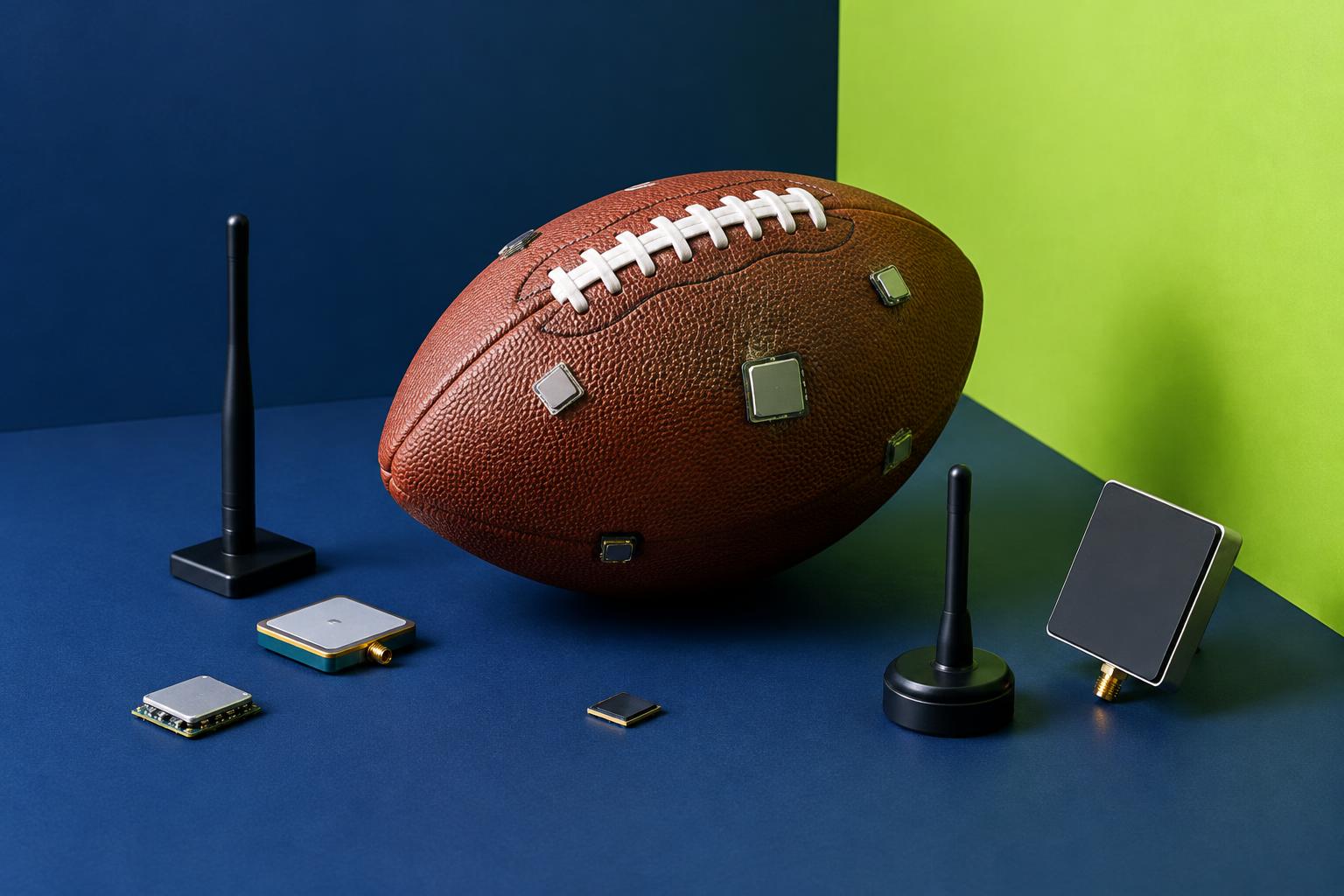
Every NFL stadium runs a tracking system built with Zebra Technologies: 20 to 30 ultra-wideband receivers around the venue pick up signals from two to three RFID tags in each player's shoulder pads, plus tags in the ball, on officials and on the chains and pylons—roughly 250 devices per game. That raw location data becomes Next Gen Stats on Amazon Web Services. AI and machine learning help turn positions into predictions and advanced stats, but the tracking itself is radio and software, not magic.
The NFL's Next Gen Stats system tracks every player on every play using RFID tags, stadium receivers and cloud computing. Here is how the data is collected, what it measures, and where AI actually fits in.
01 / The story
What is NFL Next Gen Stats?
Next Gen Stats is the NFL's player and ball tracking program, developed with Zebra Technologies and Wilson Sporting Goods and running on Amazon Web Services infrastructure. According to NFL Football Operations, its purpose is to capture real-time data for every player, on every play, anywhere on the field—and to give clubs, broadcasters and fans new ways to understand the game. [1]
The system is not one gadget. It is a venue-wide installation: receivers bolted around the stadium, tiny radio tags sewn into equipment, operators checking that everything works, and cloud software converting raw signals into numbers like speed, distance and separation.
This guide is based on the NFL's own technology pages and reporting from established publications, checked on October 17, 2026. Qlauson has not independently measured the system's accuracy. Source numbers refer to the direct links after the FAQs.
02 / The story
How the tracking hardware works
Each NFL venue has 20 to 30 ultra-wideband receivers installed around it. Players wear two to three radio-frequency identification (RFID) tags in their shoulder pads, and tags also sit in the ball, on officials, and on the pylons, sticks and chains. Altogether, the NFL estimates about 250 devices are active in a venue for any given game, with a team of three operators confirming the systems work properly. [1]
The tags emit radio signals many times per second. Because the receivers are in known fixed positions, the system can calculate where each tag is by comparing when the signal arrives at different receivers—a method similar in spirit to how GPS works, but local and much faster. Reporting on the Zebra system describes roughly half a second of latency, which is why broadcasters can show live speed during a replay. [5]
The NFL worked with equipment managers on the size and placement of the shoulder-pad tags, and game balls get their own tags. The league approved the wearable RFID system in 2014, and tracking has expanded steadily since. [4, 5]
03 / The story
What the data actually measures
The raw measurements are simple: position, and how position changes over time. From those, the system derives speed, acceleration, distance covered, and the distance between players—such as how much separation a receiver had from a defender when the ball arrived.
A famous example: running back Raheem Mostert was recorded at 23.09 miles per hour on an 80-yard touchdown, one of the fastest speeds the system has captured. Numbers like that are direct measurements from the tags, not estimates. [4]
Teams also use wearable tracking in practice through providers such as Catapult, whose GPS and local positioning devices monitor workload. That practice data is separate from the in-game Next Gen Stats system, even though the ideas overlap. [4]
04 / The story
Where AI and machine learning actually fit
The tracking itself is radio hardware and geometry—no AI required. Machine learning enters when the league and its partners turn millions of location records into higher-level statistics: the probability a catch is made, how many yards a ball carrier is expected to gain, or how a defense's formation affects a play.
Those models learn patterns from historical plays. Their outputs are probabilities and expectations, not measurements. When a broadcast says a receiver had a 35 percent catch probability, that number came from a model comparing the situation to thousands of similar past plays—not from a sensor on the field.
This distinction matters because predictions can be wrong in ways measurements usually are not. A speed reading is a fact about what happened; an expected-yards figure is an informed guess about what usually happens.
05 / The story
Who uses the data—and how
Clubs receive tracking data to analyze trends and player performance. Broadcasters use it for on-screen graphics like top speeds and separation. Fans see it through the league's Next Gen Stats website, fantasy analysis and in-stadium displays. [1, 2]
The data has also changed public conversation about the sport. Debates about whether a player is 'fast' now come with a number, and draft analysis routinely cites tracking speeds from events like the Senior Bowl, where Zebra also collects data. [3]
There are limits worth remembering. Tag position is not body position—a tag sits in the shoulder pads, not at the toes that matter for a first down. The system does not replace the officials' spot of the ball, and the league has been careful about how tracking might support officiating in the future.
06 / The story
Privacy, accuracy and what comes next
Player tracking raises real questions about who owns an athlete's movement data and how it can be used—in contract negotiations, for example. These are active discussions between the league and the players' union, and the rules can change between seasons.
On accuracy, ultra-wideband tracking is generally precise to a useful degree for speed and distance, but no radio system is perfect in a stadium full of people, metal and weather. Treat single-play numbers as very good measurements, not laboratory-grade truth.
Looking ahead, expect tracking to feed more broadcast graphics, more fan-facing stats and more team analytics. Any claim that tracking will soon replace officials or coaches is speculation; the confirmed role today is measurement and analysis, with humans still making the decisions.
A closer look
How to read tracking stats like an analyst
Separate measurement from model. Speed, distance and separation come directly from the tags. Catch probability, expected yards and similar stats come from machine-learning models trained on history. Both are useful; only the first is a direct observation.
Watch the sample size. A single game's fastest speed is one data point. Analysts look at patterns across a season before drawing conclusions about a player or a scheme.
Remember the context the tags cannot see. A receiver jogging at 12 miles per hour might be exactly where the play design wanted him. Tracking shows what bodies did; it does not show what the playbook asked for.
Put it to work
Reading NFL tracking stats
Use these questions when you see a Next Gen Stats number on a broadcast or article. They are a reading aid, not a rating of any system.
0 of 6 considered
These questions are editorial guidance, not a product score or verified assessment.
Keep learning
Further reading
- Can AI Predict an NFL Play Before It Happens?
Qlauson · Sports Technology
- Real-Time AI Streaming: Claude SSE, Tool Inputs, and Errors (2026)
Qlauson · APIs
- How to Evaluate AI Models: A Practical Testing Guide (2026)
Qlauson · AI Tools
- NFL Football Operations: Performance Tracking Data (Next Gen Stats)
External resource · The league's official description of the tracking system: receivers, RFID tags, device counts, operators and partners. Opens in a new tab.
- NFL Next Gen Stats
Primary documentation · The league's public stats site, showing the kinds of measurements and derived stats the system produces. Checked Oct 17, 2026. Opens in a new tab.
- The Athletic: What is player movement tracking technology and how do NFL teams use it?
Primary documentation · Reporting on how teams and events like the Senior Bowl use tracking data, with real speed examples. Checked Oct 17, 2026. Opens in a new tab.
- Engineering.com: The Technology Behind the NFL's Incredibly Precise Stats
Primary documentation · Technical background on RFID, GPS and local positioning wearables, including the 2014 approval and Mostert's speed record. Checked Oct 17, 2026. Opens in a new tab.
- The Verge: How the NFL tracks everything on the field but the ball
Primary documentation · Early report on the Zebra system, its shoulder-pad beacons and near-real-time latency. Checked Oct 17, 2026. Opens in a new tab.
Read next
Baseball's Robot Umpires Explained: How the ABS Challenge System Works
MLB's Automated Ball-Strike Challenge System arrived in 2026. Human umpires still call every pitch—but players can now challenge a call and let Hawk-Eye cameras settle it in seconds. Here is how it works.
Continue readingNewsletter
Get new Qlauson stories by email.
An occasional email when we publish a new guide or update an important one. No unrelated promotions, and you can unsubscribe from any email.