How Does the NFL's Yellow First-Down Line Work?
The yellow first-down line on TV is not on the field—it's a computer graphic aligned to a 3D model of the stadium. Here is how cameras, calibration and color separation paint it under players' feet.
The short answer
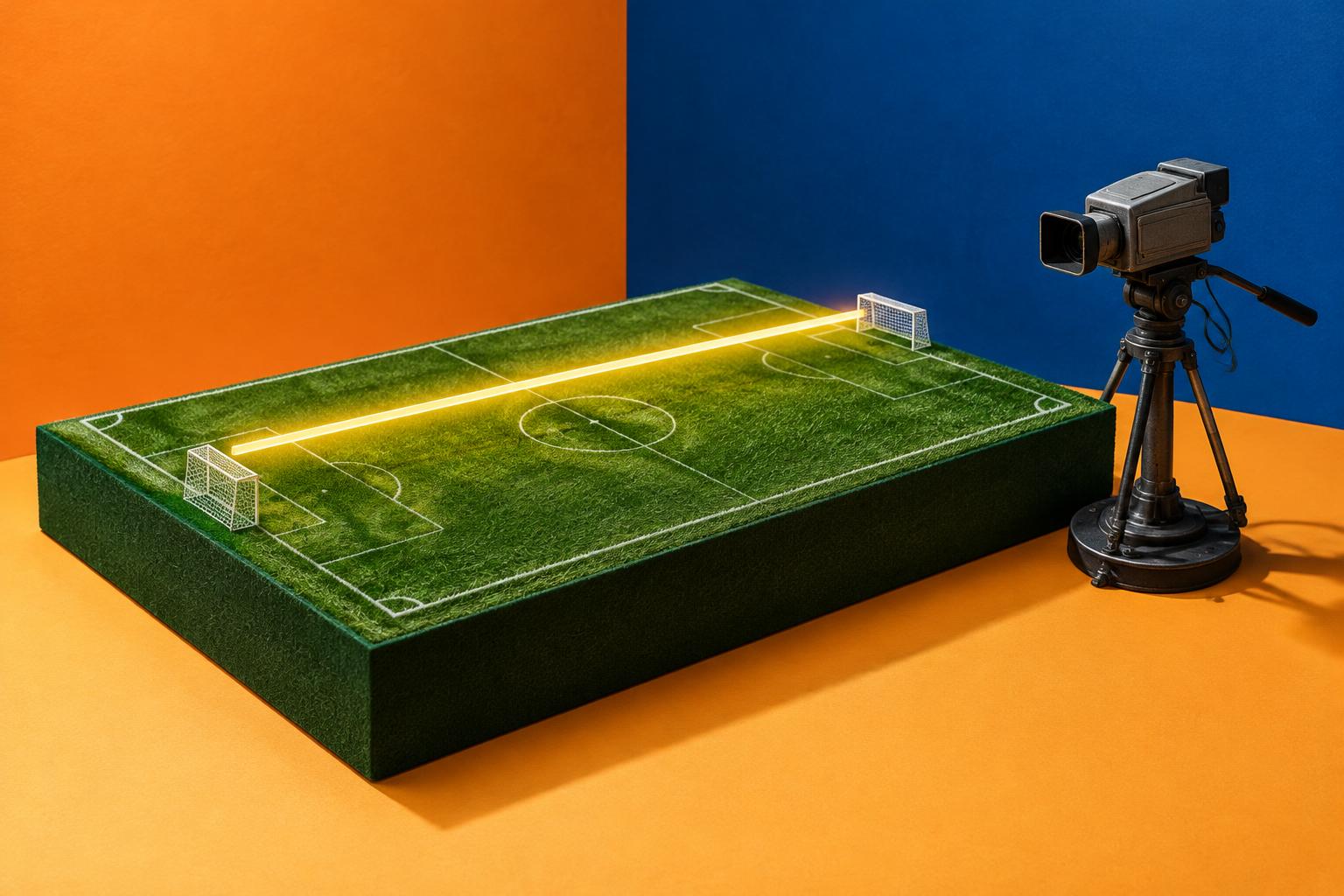
The yellow first-down line is a broadcast graphic, not a marking on the field. Before the game, technicians build a precise 3D model of the field. During the broadcast, sensors on each camera report its pan, tilt and zoom many times per second, so a computer can draw the line exactly where it belongs in the picture—and color-separation software keeps players' bodies in front of it, as if the line were painted on the grass.
The yellow first-down line on TV is not on the field—it's a computer graphic aligned to a 3D model of the stadium. Here is how cameras, calibration and color separation paint it under players' feet.
01 / The story
A line that does not exist
Fans in the stadium never see a yellow line. It exists only inside the broadcast, added to the television picture in real time. The system that made it famous—known as 1st and Ten—debuted on ESPN in 1998 and won Emmy Awards for technical achievement. [2, 4]
The idea came from the David Sarnoff Research Center, now part of SRI, where researchers developed a live video insertion system in the 1990s. Sportvision commercialized it for football, and versions of the technology have been a broadcast staple ever since. [1, 2]
This guide is based on published technical histories and explanations, checked on October 17, 2026. Modern systems are proprietary and have evolved, so exact current implementations vary by broadcaster. Source numbers refer to the direct links after the FAQs.
02 / The story
Step one: a 3D model of the field
Before the line can be drawn, the system needs to know the field's exact geometry. Technicians survey the stadium and build a computer model of the playing surface—including the fact that football fields are not flat: they have a crown for drainage, so the middle is higher than the sidelines. [3]
The model also records where each camera position sits in the stadium. Once the computer knows the field's shape and the camera's location, it can calculate where any yard line should appear in that camera's picture.
This is the same basic idea as augmented reality: a virtual object anchored to real-world coordinates. The line is easy to describe; making it sit convincingly on a curved, grass-covered surface is the hard part.
03 / The story
Step two: tracking every camera movement
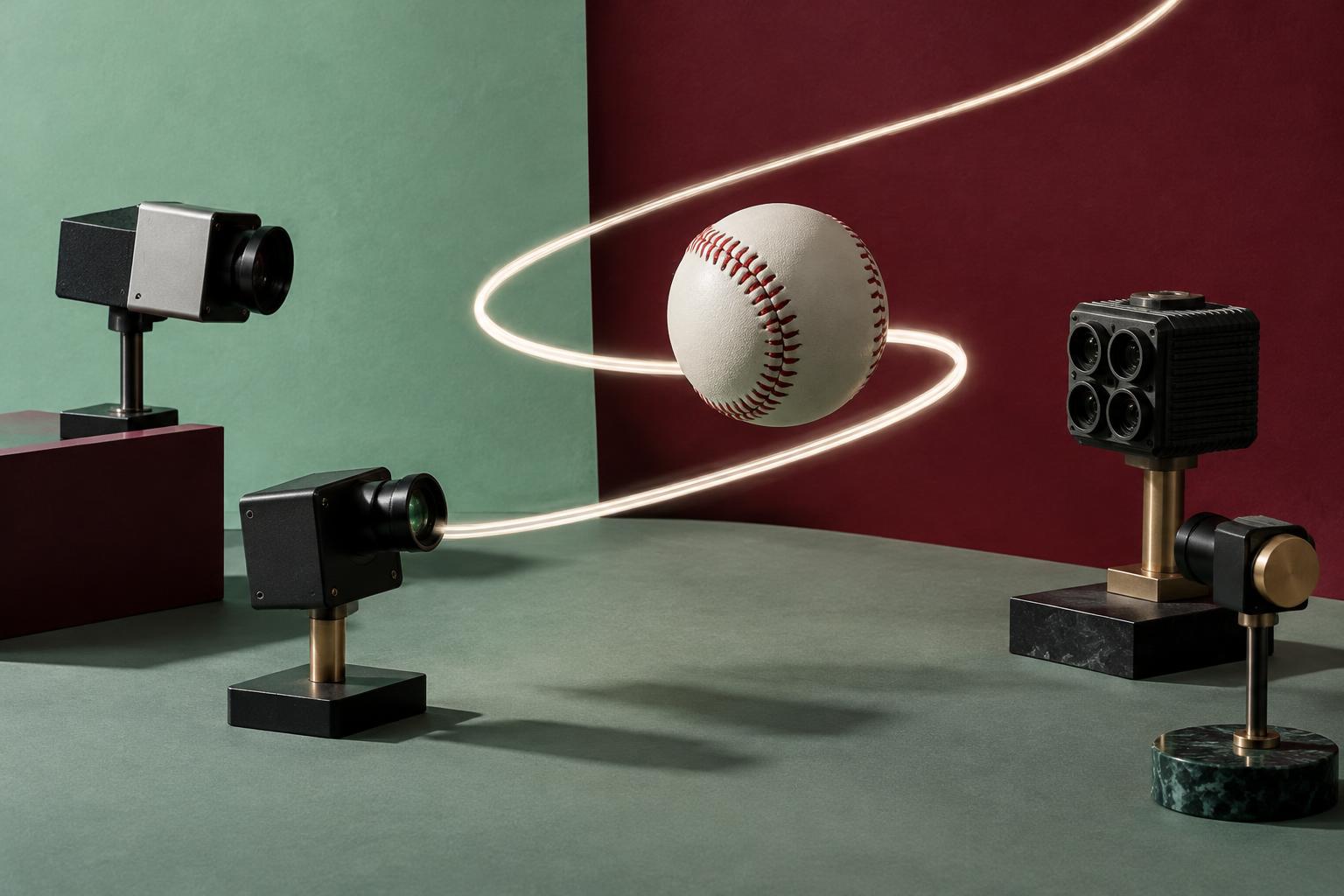
Each broadcast camera used for the line carries sensors that measure its pan, tilt and zoom continuously. As the camera follows the play, those measurements stream to the graphics computer, which recalculates the line's position for every frame of video. [3]
That is why the line stays glued to the same spot on the field while the picture moves: the computer is not matching pixels, it is doing geometry. When a camera pans left, the line's screen position shifts by exactly the amount the math says it should.
This also explains why the line sometimes vanishes. It is typically generated only for specific instrumented cameras and certain views. Cut to a handheld or unusual angle, and the graphic may not appear at all. [2]
04 / The story
Step three: painting players over the line
The trick that sells the illusion is occlusion: when a player steps on the line, the player's body covers it, just as it would cover real paint. The system does this with color separation—it knows the range of colors that make up the field, and draws the line only on pixels that look like grass or turf. [1, 3]
A player's uniform, skin and the ball are not field colors, so those pixels are left alone and the line appears to run beneath them. SRI's description of the original technology highlights high-resolution color and shape separation as its core capability. [1]
Weather can fight the system. Snow, heavy rain or unusual lighting changes the field's colors, which is why the line can flicker or look wrong in extreme conditions—the computer's idea of 'field color' no longer matches the picture.
05 / The story
Why it is a graphic, not a laser or projection
A common guess is that the line is projected onto the field like stadium lighting. It is not: nothing on the grass changes. The line is inserted into the video signal between the camera and your screen, which is why only TV viewers see it.
The same insertion approach powers other broadcast graphics: the line of scrimmage marker, virtual advertising boards and distance lines on field-goal attempts. Once a broadcaster can anchor one virtual object to the field, anchoring others is the same math with different artwork.
Related technology has also moved in-stadium in other sports—projection-mapped ice and court shows exist—but those are separate systems. The first-down line remains a television effect.
06 / The story
How the technology has evolved
Since 1998, computing power has turned a room-sized specialty system into standard broadcast equipment. Modern versions handle high-definition and 4K pictures, more camera angles and additional graphics like the line-to-gain arrow and possession indicators. [2, 5]
The line also changed what viewers expect. A generation of fans treats it as part of the game itself, and broadcasters now layer data—like tracking-based stats—onto the same augmented picture. IEEE's history of the system notes how quickly it went from marvel to invisible utility. [4]
What has not changed is the principle: know the field's shape, know the camera's aim, draw only on field-colored pixels. Everything else is refinement.
A closer look
Noticing the line's limits on game day
Watch which camera views carry the line. It usually appears on the main sideline cameras and disappears on aerial, end-zone or handheld shots—a sign that only certain cameras feed the graphics computer.
Watch what happens in bad weather. Snow or a muddy, discolored field can confuse the color separation, making the line flicker or bleed onto players. That is the system failing gracefully, not a broken stadium.
Remember what the line is for. It shows the distance needed for a first down; it is not an official measurement. The officials' spot and the physical chains still decide the game.
Put it to work
The yellow line in six points
Use these to check your understanding of how the broadcast graphic works.
0 of 6 considered
These questions are editorial guidance, not a product score or verified assessment.
Keep learning
Further reading
- How the NFL Uses AI and Player Tracking to Analyze Every Play
Qlauson · Sports Technology
- Real-Time AI Streaming: Claude SSE, Tool Inputs, and Errors (2026)
Qlauson · APIs
- Multimodal AI: How to Work with Vision + Text (2026)
Qlauson · AI Tools
- SRI: The first-down marker—how technology changed the game
External resource · The research center's own account of the Live Video Insertion System, its 1998 ESPN debut and its color-separation approach. Opens in a new tab.
- Scienceline: How do they make the first down line appear?
Primary documentation · Plain-language explanation of the 1st and Ten line, its Sportvision history and its relation to weather-map graphics. Checked Oct 17, 2026. Opens in a new tab.
- HowStuffWorks: How the First-Down Line Works
Primary documentation · Detailed walkthrough of field modeling, camera instrumention and real-time graphic insertion. Checked Oct 17, 2026. Opens in a new tab.
- IEEE-USA InSight: The Making of Football's Yellow First-and-Ten Line
Primary documentation · Engineering history of the system and how quickly it became an invisible part of broadcasts. Checked Oct 17, 2026. Opens in a new tab.
- Ars Technica: First and 10—the technology behind the Super Bowl broadcast
Primary documentation · Context on the broader broadcast infrastructure that graphics like the line depend on. Checked Oct 17, 2026. Opens in a new tab.
Read next
How the NFL Uses AI and Player Tracking to Analyze Every Play
The NFL's Next Gen Stats system tracks every player on every play using RFID tags, stadium receivers and cloud computing. Here is how the data is collected, what it measures, and where AI actually fits in.
Continue readingNewsletter
Get new Qlauson stories by email.
An occasional email when we publish a new guide or update an important one. No unrelated promotions, and you can unsubscribe from any email.