Baseball's Robot Umpires Explained: How the ABS Challenge System Works
MLB's Automated Ball-Strike Challenge System arrived in 2026. Human umpires still call every pitch—but players can now challenge a call and let Hawk-Eye cameras settle it in seconds. Here is how it works.

The short answer
Baseball's 'robot umps' are real but limited: starting with the 2026 season, MLB uses the Automated Ball-Strike (ABS) Challenge System. Human umpires still call every pitch. Each team gets two challenges—kept if successful—and only the pitcher, catcher or batter can request one by tapping their hat or helmet right after the pitch. Hawk-Eye cameras then show whether the pitch crossed the strike zone, and the call stands or is overturned within seconds.
MLB's Automated Ball-Strike Challenge System arrived in 2026. Human umpires still call every pitch—but players can now challenge a call and let Hawk-Eye cameras settle it in seconds. Here is how it works.
01 / The story
What changed in 2026
In September 2025, MLB's Joint Competition Committee voted to bring the Automated Ball-Strike Challenge System to the major leagues for the 2026 season, after years of testing in the Minor Leagues and use during 2025 Spring Training and the 2025 All-Star Game. The system is sponsored as 'powered by T-Mobile.' [1, 2]
This is a challenge system, not full automation. A human home-plate umpire still calls every ball and strike. Technology enters only when a player disputes a call—and only a limited number of times per game.
This guide reflects MLB's published explanations of the system, checked on October 17, 2026. Rules can be adjusted between seasons, so check MLB's current documentation for the latest details. Source numbers refer to the direct links after the FAQs.
02 / The story
How a challenge works
Each team starts the game with two challenges. A successful challenge is kept; a failed one is lost. Only the pitcher, catcher or batter involved in the pitch can initiate a challenge, and the request must come immediately after the pitch—signaled by tapping the hat or helmet. Help from the dugout or other players is not allowed. [1]
Once a challenge is signaled, the Hawk-Eye tracking system's view of the pitch is shown on the stadium video board and broadcasts. The graphic shows whether any part of the ball passed through the strike zone, and the call is confirmed or overturned. The whole process takes roughly a few seconds—fast enough that the game barely pauses.
The design deliberately puts the decision in players' hands. Catchers, who see hundreds of pitches up close, have proven especially central to challenge strategy in testing.
03 / The story
The technology: Hawk-Eye cameras
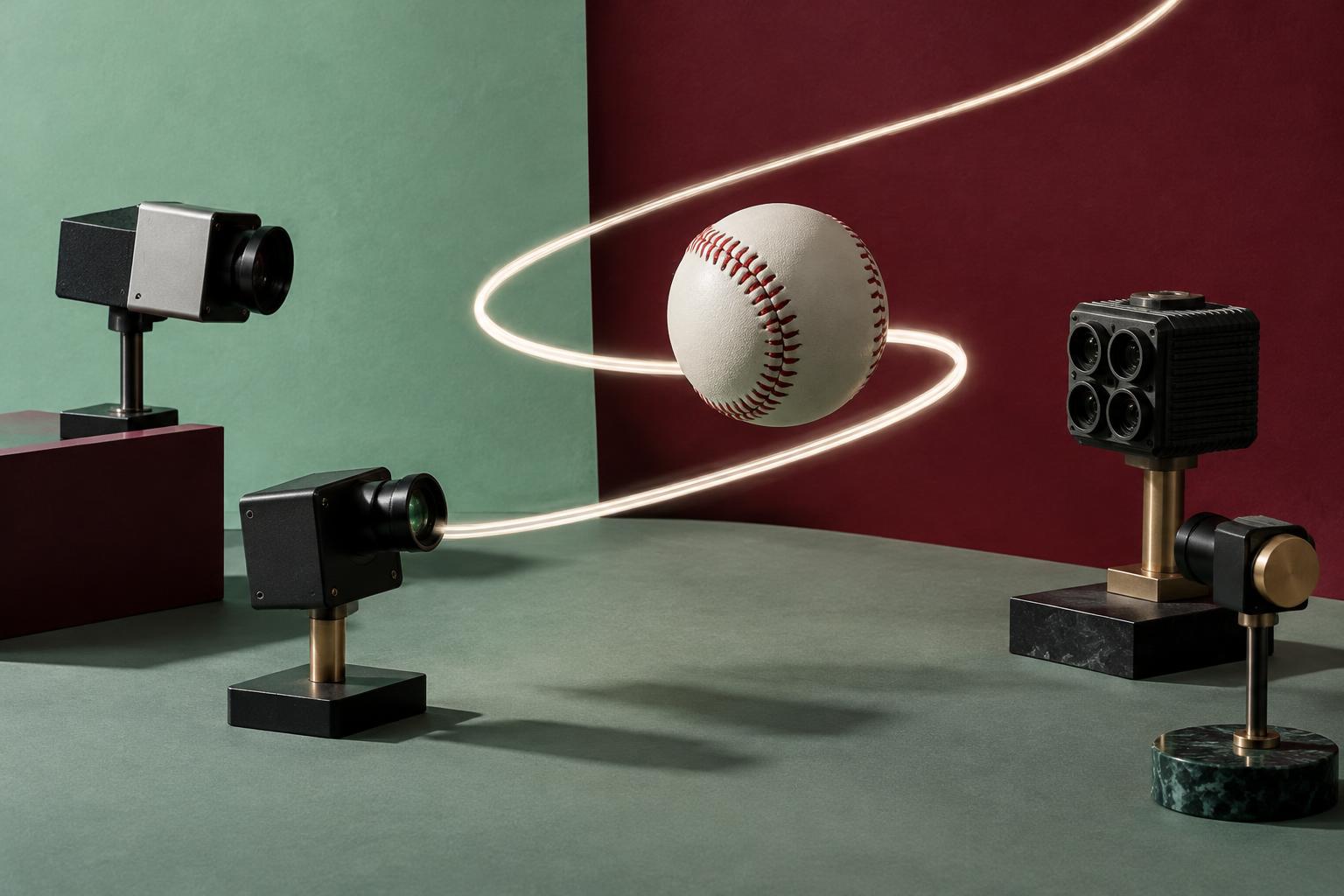
ABS runs on Hawk-Eye, a high-speed camera system long known from professional tennis line-calling. A network of cameras around the ballpark tracks the ball's trajectory from the pitcher's hand to the catcher's glove, building a precise three-dimensional path for every pitch. [3]
The strike zone is defined as a three-dimensional volume over home plate, with its top and bottom adjusted to each batter's stance. The system checks whether the ball's path intersected that volume. This is geometry from camera measurements—not an AI guessing what 'looks like' a strike.
Hawk-Eye has powered MLB's Statcast tracking since 2020, so the 2026 change built on cameras already installed in every ballpark rather than introducing entirely new hardware. [3]
04 / The story
Why a challenge system instead of full robot umpires
MLB describes the challenge system as a middle ground. A fully automated system would call every pitch by camera, removing the human umpire's judgment entirely. The challenge approach keeps the traditional rhythm of the game while correcting the small number of calls that matter most—and that players feel most strongly about. [1]
The human baseline is already high: big-league umpires call roughly 94 percent of pitches correctly, according to UmpScorecards, an independent tracker cited by MLB. The challenge system targets the remaining few percent without redesigning the sport. [1]
Testing in the minors and in 2025 spring training showed games stayed fast and players adapted quickly—evidence that helped convince the competition committee to approve the change.
05 / The story
Accuracy, limits and fairness questions
No measurement system is perfect. Hawk-Eye's tracking is extremely precise, but the strike zone's edges depend on each batter's measured stance, and any system has a margin of error. The challenge graphic presents a definitive verdict; the underlying measurement is a very good estimate.
Fairness debates continue. Some argue a camera-defined zone is more consistent than any human; others note that framing skill—how catchers present a pitch—loses value, and that teams with savvier challenge strategies gain an edge. The two-challenge limit also means some wrong calls will stand simply because challenges ran out.
One misconception to avoid: the system does not eject umpires or overrule them automatically. Umpires remain in charge of the game; ABS is a review tool, like instant replay for the strike zone.
06 / The story
What could come next
If the challenge system runs smoothly, MLB could adjust the number of challenges or expand automation in future seasons. A fully automated strike zone remains technically possible—the cameras already track every pitch—but the league has publicly favored the challenge model, and any change would need competition-committee approval. Treat predictions about full robot umpires as possibilities, not plans. [2]
For fans, the practical change is simple: expect a few dramatic hat-taps per game, a quick video-board verdict, and fewer arguments that change nothing. The human umpire is still there—the robots just got a appeal process.
A closer look
Watching a game with ABS: what to notice
Watch who challenges. Only the pitcher, catcher or batter can call for a review, and they must decide instantly, without dugout advice. Catchers often become a team's challenge strategist because they see every pitch's location up close.
Watch when challenges are spent. With only two per team—kept when successful—most clubs save at least one for late, high-stakes situations. An early failed challenge can change how a team plays the eighth inning.
Watch the zone graphic, not just the verdict. The video-board display shows the pitch path relative to the batter's personalized zone. Over a season, those graphics teach viewers how the rulebook zone actually maps to what they see on screen.
Put it to work
ABS challenge system basics
Use these questions to check your understanding of the 2026 rules. They are a reading aid, not official rules interpretation.
0 of 6 considered
These questions are editorial guidance, not a product score or verified assessment.
Keep learning
Further reading
- How Baseball Technology Measures a Pitch's Speed, Spin and Movement
Qlauson · Sports Technology
- How Does the NFL's Yellow First-Down Line Work?
Qlauson · Sports Technology
- How to Evaluate AI Models: A Practical Testing Guide (2026)
Qlauson · AI Tools
- MLB.com: Ball-Strike Challenge System for 2026
External resource · MLB's official explainer: the committee vote, two-challenge rules, who may challenge, the hat-tap signal and the umpire accuracy context. Opens in a new tab.
- MLB.com: ABS Challenge System—what it means for the 2026 season
Primary documentation · MLB's fan-oriented overview of the system's arrival, history and on-field operation. Checked Oct 17, 2026. Opens in a new tab.
- MLB.com: Statcast glossary
Primary documentation · Official background on Hawk-Eye, the camera system behind Statcast since 2020 and the ABS challenge verdicts. Checked Oct 17, 2026. Opens in a new tab.
Read next
How the NFL Uses AI and Player Tracking to Analyze Every Play
The NFL's Next Gen Stats system tracks every player on every play using RFID tags, stadium receivers and cloud computing. Here is how the data is collected, what it measures, and where AI actually fits in.
Continue readingNewsletter
Get new Qlauson stories by email.
An occasional email when we publish a new guide or update an important one. No unrelated promotions, and you can unsubscribe from any email.