Brain-Computer Interfaces: How Close Are We to Controlling Devices With Our Thoughts?
People with paralysis are already moving cursors and generating speech with implanted brain-computer interfaces. Here is what the published studies actually show, what the different approaches trade off, and what remains unsolved.
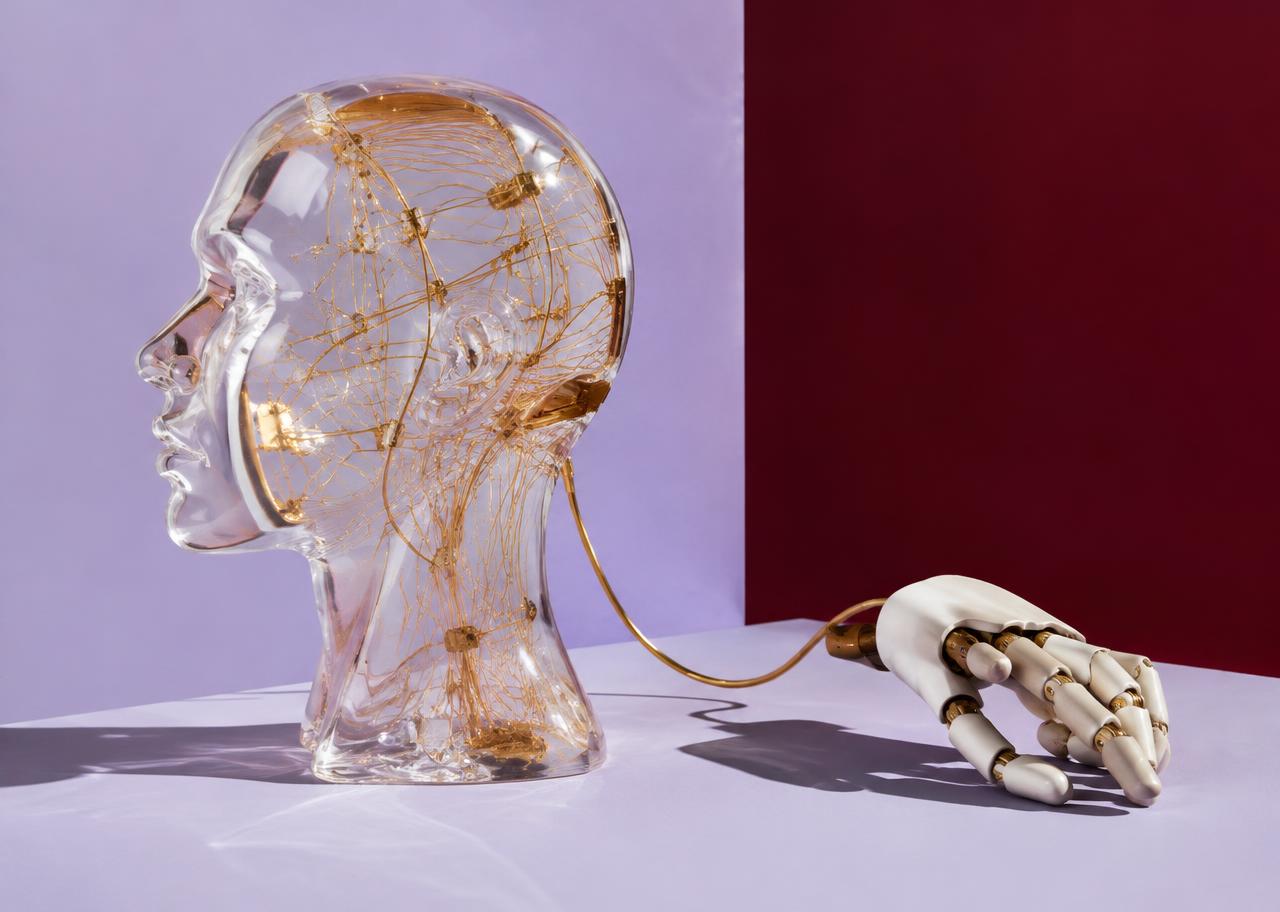
The short answer
Controlling a device with deliberately generated brain activity is no longer science fiction: in published clinical research, people with paralysis have moved cursors, operated computers and produced synthetic speech using implanted electrodes. What remains experimental is reliable, long-term, widely available implanted assistance. Speech systems decode attempted speech—patterns a participant deliberately produces during training—not private thoughts. The main open questions are longevity, safety over years, support after trials end, and who pays for it all.
People with paralysis are already moving cursors and generating speech with implanted brain-computer interfaces. Here is what the published studies actually show, what the different approaches trade off, and what remains unsolved.
01 / The story
How a thought becomes an action
A brain-computer interface (BCI) does three things. Electrodes measure electrical activity from the brain. Software pulls out useful patterns from that activity. A decoder—a trained algorithm—maps those patterns to an intended action, such as moving a cursor or attempting to say a word. [1]
The speech studies that make headlines train on activity recorded while a participant attempts to speak. The system learns to recognize the patterns of attempted speech, sometimes with help from a language model that predicts likely words. That is very different from reading beliefs, memories or a private inner monologue. A fluent-sounding synthetic sentence is not proof that every word was decoded with certainty. [2, 3, 4]
Calibration matters. These systems are trained for each individual, and performance depends on the task, the vocabulary and the participant. Comparing a bits-per-second number from one study with a words-per-minute number from another is comparing different things. [1]
02 / The story
Four approaches, four trade-offs
Not all BCIs enter the brain the same way, and the differences are real trade-offs rather than a simple ranking from bad to good.
Penetrating electrodes, such as the Utah-style arrays used in Stanford and UC Davis research and Neuralink's implanted threads, sit inside brain tissue and record high-resolution activity. They require neurosurgery, and tissue response, signal stability and hardware longevity are open concerns. [2, 3, 8]
Cortical-surface recording (often called ECoG) places electrodes on the brain's surface rather than inside it. UCSF's speech work uses this approach, and Precision Neuroscience's thin Layer 7 array rests on the cortex. It still requires access through the skull. [4, 6, 9]
Synchron's Stentrode takes a third route: it is delivered through blood vessels into a vein near the motor cortex, avoiding open brain surgery—though it is still an invasive vascular procedure with its own risks. [5]
Non-invasive EEG headsets measure activity through the scalp. There is no surgery, but the signals are weaker and mixed, and performance is variable. A consumer headset's availability is not proof of clinical benefit. [1, 10]
| Approach | Examples | Main limitation |
|---|---|---|
| Penetrating electrodes | Stanford/UC Davis speech studies, Neuralink threads | Neurosurgery; tissue response and longevity |
| Cortical surface (ECoG) | UCSF speech system, Precision Layer 7 | Still requires opening the skull |
| Endovascular | Synchron Stentrode | Vascular procedure with its own risk profile |
| Scalp EEG (non-invasive) | Consumer and research headsets | Weaker, mixed signals; variable performance |
03 / The story
What the clinical studies actually showed
The strongest evidence comes from small, careful studies—and the details matter.
In 2023, Stanford researchers reported that one participant with ALS reached 62 words per minute using attempted-speech decoding. The word error rate was 9.1% with a 50-word vocabulary and 23.8% with a 125,000-word vocabulary. Those are vocabulary-dependent results, not a universal '91% accurate' system. [2]
In 2024, UC Davis reported a participant with ALS whose four arrays recorded from 256 electrodes. The system reached 99.6% accuracy with a 50-word vocabulary on the first day of use; later performance was about 97.5% accuracy with conversation at roughly 32 words per minute. The first-day small-vocabulary number and the later large-vocabulary speed come from different tests and should not be merged into one claim. [3]
In March 2025, a UCSF/Berkeley team demonstrated streaming speech in one participant with severe paralysis, decoding in 80-millisecond increments and personalizing the synthetic voice toward the participant's pre-injury voice. The 80 milliseconds is a model update interval, not a guarantee of end-to-end conversational delay. [4]
Synchron's SWITCH study followed four implanted participants for 12 months and reported no device-related serious adverse events causing death or permanent increased disability, no vessel occlusion and no device migration. Computer use included assistive components such as eye tracking, so not every cursor movement was brain-only control. Four participants cannot rule out uncommon complications. [5]
Neuralink has published participant updates showing cursor control and computer use. These are company demonstrations, not controlled comparisons against other systems. [8]
04 / The story
Recent developments, in proportion
On September 14, 2026, a peer-reviewed UCSF-led study in Nature Neuroscience showed that one high-density surface implant could decode speech and gestures simultaneously, with avatar control demonstrated using parallel decoders. Three participants contributed isolated-movement experiments. It is a route toward richer communication—not evidence that every participant achieved unrestricted conversation. [6]
In June 2026, UC Davis reported a Nature Medicine study in which a man with ALS used a BCI independently at home for communication and computer interaction. Independent home use is an important real-world milestone, but it remains an individual result, not population-wide reliability. [7]
In April 2025, Precision Neuroscience received FDA 510(k) clearance for an electrode array usable for up to 30 days for recording and mapping. That is a narrow regulatory clearance for a component—not approval of a chronic, wireless, thought-controlled assistive platform. [9]
And in September 2026, a Nature Neuroscience commentary argued for separating research from clinical care and guaranteeing continued participant support. That is an expert ethical argument, not a new trial or binding rule—but it points at questions the field has not answered. [12]
05 / The story
Safety, privacy and the questions nobody has answered
Implantation can involve bleeding, infection, tissue injury, seizures and anesthesia risk, and devices can fail or drift over time. Endovascular systems swap in a different risk profile rather than eliminating risk. The FDA's guidance for implanted BCIs calls for device-specific testing and clinical evaluation. [5, 13]
Brain-signal data is sensitive even without any 'mind reading.' The U.S. Government Accountability Office has flagged unclear data ownership, consent and privacy protections. Security evaluation needs to cover unauthorized access, wireless links, software updates and command integrity. [1, 13]
One question deserves more attention than it gets: who maintains an implant? Repairs, replacement, removal and software support after a trial ends—or after a company closes—are ethical and practical issues, not aftercare details. [1, 12]
There is also a distinction between assistive and rehabilitative BCIs. Communication systems compensate for lost function. EEG-linked rehabilitation tries to improve recovery itself: a 2025 meta-analysis of 21 randomized trials with 886 stroke patients found a pooled 3.69-point advantage on a standard upper-limb motor score over controls, with moderate-quality evidence. That is a modest average improvement in studied protocols—not a cure. [10]
06 / The story
So how close are we?
For the specific job of restoring communication and basic computer control to people with severe paralysis, the answer is: it is already happening in research settings, and the results are genuinely impressive. [2, 3, 7]
For everything beyond that—reliable implants that last decades, broad availability, consumer thought-controlled devices—the honest answer is that nobody can give you a defensible date. Small selected samples, task-specific benchmarks, calibration burden, electrode lifetime and reimbursement all stand between today's demonstrations and widespread use. No single approach has proven best across safety, speed, longevity and accessibility. [1]
The milestones worth watching in 2027: larger multi-participant trials with pre-registered endpoints, independent home-use results like the UC Davis study, regulatory decisions on complete systems rather than components, and published long-term durability data. If those appear, the field is maturing. If headlines keep outpacing peer-reviewed results, be skeptical.
A closer look
What we verified and what stays uncertain
This guide is desk research based on peer-reviewed studies, regulator documents and official trial information, checked on October 17, 2026. Qlauson has not tested any device. Numbers below come from individual published studies with small numbers of participants; they show what is possible, not what is typical.
Uncertain as of publication: long-term implant durability beyond a few years, how results generalize across different disabilities, reimbursement and maintenance arrangements, and whether any approach will dominate. Company demonstration videos are not controlled trials.
Put it to work
How to read any BCI claim
Before believing a headline about mind-controlled devices, check:
0 of 5 considered
These questions are editorial guidance, not a product score or verified assessment.
Keep learning
Further reading
- What Are AI Agents? How They Work and What They Can Actually Do
Qlauson · Artificial Intelligence
- Can Your Laptop Run AI Locally? Memory, Speed and Real Costs
Qlauson · AI Models & Computing
- How Do Autonomous Robots Navigate and Avoid Obstacles?
Qlauson · Robotics and Automation
- Brain-Computer Interfaces: Applications, Challenges, and Policy Options — U.S. Government Accountability Office, Dec 17, 2024
External resource · Official technology assessment covering applications, challenges and policy gaps. Opens in a new tab.
- A high-performance speech neuroprosthesis — Nature, Aug 23, 2023
Primary documentation · Stanford study: 62 words/minute attempted-speech decoding in one participant with ALS. Checked Oct 17, 2026. Opens in a new tab.
- An Accurate and Rapidly Calibrating Speech Neuroprosthesis — New England Journal of Medicine, Aug 14, 2024
Primary documentation · UC Davis study: 256 electrodes, rapid calibration, large-vocabulary accuracy. Checked Oct 17, 2026. Opens in a new tab.
- A streaming brain-to-voice neuroprosthesis to restore naturalistic communication — Nature Neuroscience, Mar 31, 2025
Primary documentation · UCSF/Berkeley streaming speech with personalized synthetic voice. Checked Oct 17, 2026. Opens in a new tab.
- Safety of a Fully Implanted Endovascular BCI for Severe Paralysis (SWITCH) — JAMA Neurology, Jan 9, 2023
Primary documentation · Synchron Stentrode 12-month safety results in four participants. Checked Oct 17, 2026. Opens in a new tab.
- Simultaneous speech and gesture decoding for multimodal communication in paralysis — Nature Neuroscience, Sep 14, 2026
Primary documentation · Recent peer-reviewed multimodal decoding study. Checked Oct 17, 2026. Opens in a new tab.
- Brain-computer interface enables independent, accurate communication for man living with ALS — UC Davis Health, Jun 15, 2026
Primary documentation · Institutional account of independent home-use research. Checked Oct 17, 2026. Opens in a new tab.
- PRIME Study Progress Updates — Neuralink, May 8 and Aug 21, 2024
Primary documentation · Company participant updates; not independently controlled trials. Checked Oct 17, 2026. Opens in a new tab.
- Precision Neuroscience receives FDA clearance for brain implant — MedTech Dive, Apr 21, 2025
Primary documentation · Regulatory reporting on the 30-day recording/mapping clearance. Checked Oct 17, 2026. Opens in a new tab.
- BCI-based training for post-stroke upper-limb rehabilitation: a meta-analysis — Journal of NeuroEngineering and Rehabilitation, Mar 3, 2025
Primary documentation · Systematic review of 21 randomized trials, 886 patients. Checked Oct 17, 2026. Opens in a new tab.
- An instantaneous voice-synthesis neuroprosthesis — Nature, Jun 12, 2025
Primary documentation · Expressive voice synthesis including intonation, in one participant. Checked Oct 17, 2026. Opens in a new tab.
- Ethical considerations for implantable human brain-computer interfaces — Nature Neuroscience, Sep 7, 2026
Primary documentation · Commentary on research-care separation and participant support. Checked Oct 17, 2026. Opens in a new tab.
- Implanted BCI Devices for Patients with Paralysis or Amputation — FDA guidance, May 20, 2021
Primary documentation · Final FDA guidance on non-clinical testing and clinical considerations. Checked Oct 17, 2026. Opens in a new tab.
Read next
Gene Editing Technology: How CRISPR Could Change Medicine
CRISPR is now an approved medicine for specific blood disorders, and base and prime editing are moving through trials. Here is what is actually approved, what is still experimental, and what stands between the lab and routine care.
Continue readingNewsletter
Get new Qlauson stories by email.
An occasional email when we publish a new guide or update an important one. No unrelated promotions, and you can unsubscribe from any email.