Apple HomeView: Apple's Smart-Home Hub, Siri AI, Price and Availability
Apple HomeView is official: a 7-inch smart display with Siri AI, face recognition for six people, Matter and Thread support, a $299 price and a November 13 ship date. Here is what is confirmed, what is limited, and what to check before buying.
The short answer
Apple HomeView is confirmed and real: a 7-inch smart display announced on October 13, 2026, priced at $299, with pre-orders open and availability starting November 13. It runs a new, more conversational Siri AI, recognizes up to six household members by face, and acts as a Matter controller and Thread border router. The main limits are just as clear: Siri AI starts in English only with possible usage limits, the device needs a recent iPhone or iPad, and some camera features require a paid iCloud+ plan.
Apple HomeView is official: a 7-inch smart display with Siri AI, face recognition for six people, Matter and Thread support, a $299 price and a November 13 ship date. Here is what is confirmed, what is limited, and what to check before buying.
01 / The story
What Apple actually announced
On October 13, 2026, Apple introduced Apple HomeView at its "Welcome Home" event in Cupertino. This is not a rumor or a concept: it is a shipping product with a press release, a product page, a pre-order page and a price. HomeView is Apple's first smart display, designed to sit at the center of a home and combine entertainment, communication and smart-home control in one place. [1, 2]
The device has a 7-inch Liquid Retina display with True Tone. Apple says brightness ranges from 500 nits for sunny rooms down to 0.3 nits for a bedside, and that some features respond to how close you are, showing more information as you approach. There are no buttons: you use the touchscreen and your voice. [2, 6]
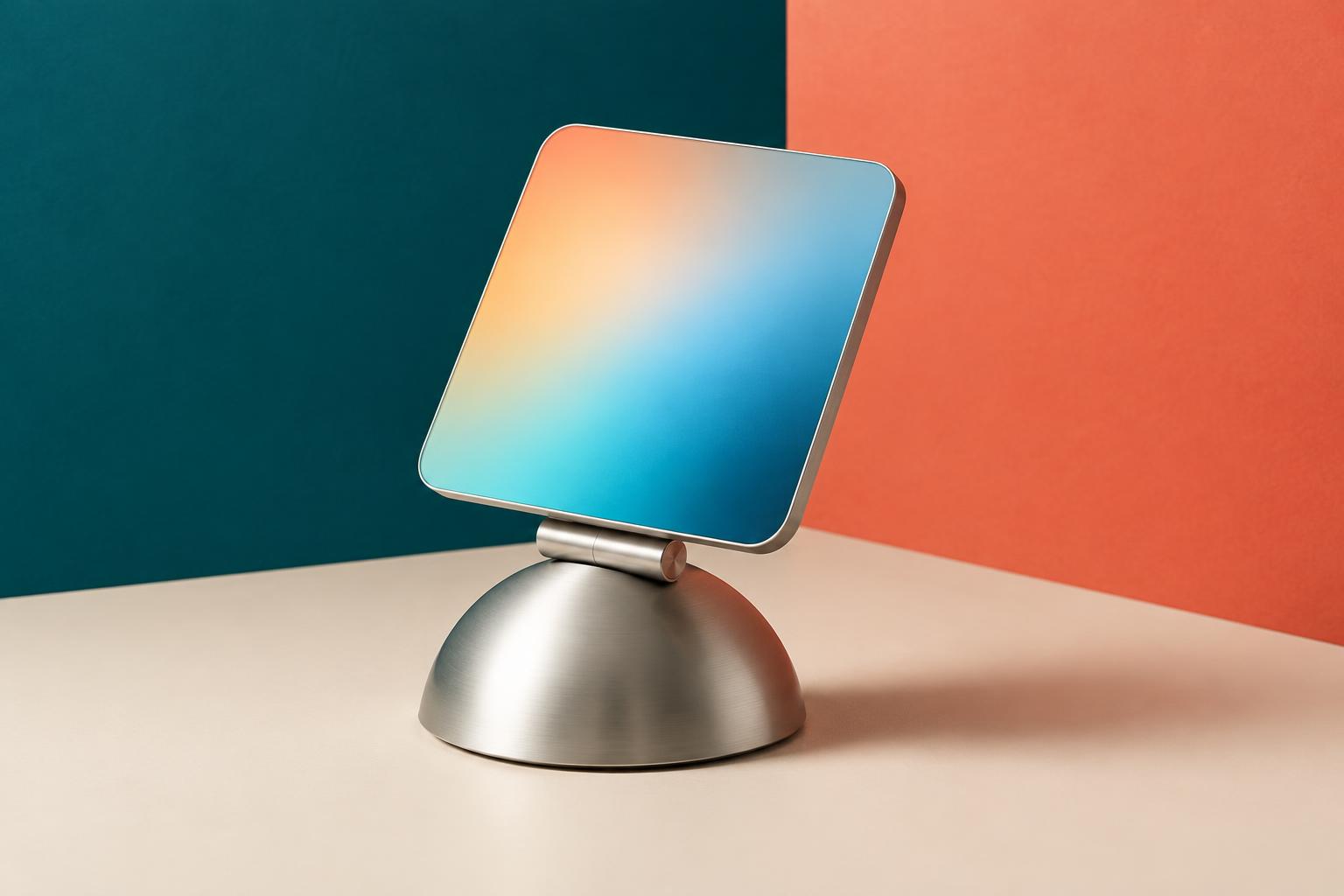
Two versions exist. The tabletop model has a domed aluminum base with a stainless steel hinge that lets you adjust the screen angle, and the base contains a down-firing woofer with two force-canceling passive radiators supporting two full-range drivers in the display. The wall-mounted version drops the base; Apple says ADT professional installation is available for it in most areas. Both come in four colors: Silver, Starlight, Rose Pink and Space Gray. [1, 2, 4]
This guide is based on Apple's official announcement, product and shop pages, and reporting from established technology publications, all checked on October 17, 2026. Qlauson has not tested the device. Source numbers refer to the direct links after the FAQs.
02 / The story
Price, colors and availability—confirmed
HomeView starts at $299 in the United States, and pre-orders opened on October 13, 2026, the day of the announcement. Apple's shop page lists availability starting November 13, 2026. The four colors—Silver, Starlight, Rose Pink and Space Gray—are each listed at $299. [2, 3]
Pricing outside the United States was not part of the material we checked, and taxes, storage of accessories or installation services can change the real total. The wall-mounted version may add an installation cost if you use ADT's service. Confirm the final price on Apple's store page for your region before ordering. [2]
At the same event, Apple also announced a new Apple TV 4K at $299 with a redesigned remote, and a HomePod Mini in new colors at $149. Those are separate products; they are mentioned here only so readers do not confuse the announcements. [5]
03 / The story
Siri AI: the biggest change inside
HomeView is built around Siri AI, which Apple describes as an entirely new version of Siri that is more capable and more conversational, with broader world knowledge. On HomeView it powers richer music discovery and onscreen awareness, and when paired with an Apple Intelligence-enabled device it can draw on a user's personal context. [1]
Two limits are stated plainly by Apple and matter before you buy. First, Siri AI is available in English to start. Second, usage limits may apply. If your household speaks another language day to day, or you expect unlimited assistant use, treat those as open questions and check Apple's current language and feature list. [2]
Reporting around the launch notes that the Siri generative AI chatbot is currently in beta. A beta label means behavior can change between software updates, so early reviews may not match the experience months later. [4]
04 / The story
A hub for the whole household
HomeView recognizes users by their faces and adapts what it shows: each person can reach their own Messages, FaceTime, Calendar, Reminders and Find My. Up to six members of a household can be enrolled through the Home app, and each needs an Apple Account and an iPhone or iPad running the latest software. [1, 2]
Compatibility has a firm floor: HomeView requires an iPhone with iOS 27.2 or later, or an iPad with iPadOS 27.2 or later. A household that only uses Android phones cannot meaningfully set this device up—that is a confirmed requirement, not a preference. [2]
As a smart-home controller, HomeView works with the Home app to manage compatible accessories, and it is a Matter controller and a Thread border router. In plain language, Matter is a shared standard that lets accessories from different brands work together, and Thread is a low-power mesh network many sensors and locks use. A border router connects that mesh to your home network, so you do not need a separate hub box for those devices. [3, 4]
05 / The story
Cameras, security and the iCloud+ catch
HomeView can show live feeds from compatible cameras—reporting at launch described up to nine video feeds at once—and it works with HomeKit Secure Video. With a supported iCloud+ subscription, Apple says HomeView delivers intelligent, end-to-end encrypted recognition of people, familiar faces, pets, packages and vehicles, plus video descriptions that summarize what happened in a clip without watching it. [1, 4]
The catch is the subscription: those intelligent recognition features are tied to iCloud+, which is a paid plan. The $299 device price is not the whole cost if you want the full camera experience. Check which iCloud+ tier covers the number of cameras you own. [1]
Apple positions privacy as a core design point, including on-device face recognition for personalization and end-to-end encryption for camera recognition. As with any always-present camera and microphone in a home, read Apple's current privacy page for the device and decide which rooms are appropriate before installing it.
06 / The story
What was rumor, and what is now fact
A smart-home display from Apple was rumored for years. Reporting before the event said Apple originally planned to launch one in 2024 alongside an AI-powered Siri upgrade, and had to change plans after delaying that Siri work. The October 13 announcement ended that speculation: the product, the price and the ship date are now official. [3]
Some questions remain open and should not be treated as settled: how Siri AI performs outside English, whether usage limits affect heavy households, long-term software support length, and how well third-party Matter accessories behave in practice. None of those can be answered by a press release; they need hands-on time and independent reviews after November 13.
Be cautious with any article or video claiming benchmark results, sound-quality verdicts or reliability judgments before the ship date. Until units are in homes, those claims are predictions, not evidence.
07 / The story
Should you consider one?
HomeView makes the most sense for a household already using iPhones and Home app accessories, where several people want a shared screen for music, calls, calendars and camera feeds. The six-person face recognition is the standout idea: the device shows different content depending on who walks up.
It makes less sense if your home runs on another voice assistant ecosystem, if nobody in the house has a recent iPhone or iPad, or if you mainly want a speaker—the HomePod Mini at $149 covers that job for less. Competing smart displays from Amazon and Google exist at various prices; compare current models rather than last year's reviews.
If you are undecided, waiting a few weeks after November 13 is reasonable. Independent reviews will answer the questions an announcement cannot: real Siri AI reliability, camera recognition accuracy and how the display holds up in a busy kitchen.
A closer look
Practical notes before you pre-order
Check the software floor first. HomeView requires iOS 27.2 or iPadOS 27.2 or later on the household's devices. If a family member's iPhone cannot run that version, their personalization will not work, and setup itself depends on a compatible device. Confirm compatibility in Settings before ordering, not after unboxing.
Budget for the extras that turn features on. The wall-mounted version may involve paid installation, and the intelligent camera recognition features require a supported iCloud+ subscription. The $299 headline price is the starting point, not the full cost of the setup shown in Apple's marketing.
Think about placement as a privacy decision. A device with a camera and microphones in a kitchen or living room is different from one in a bedroom. Decide as a household where it belongs, and review Apple's privacy controls for the camera and Siri before guests and children are enrolled.
Put it to work
HomeView readiness checklist
Use these questions to decide whether a pre-order makes sense for your home. They are a decision aid, not a product rating.
0 of 6 considered
These questions are editorial guidance, not a product score or verified assessment.
Keep learning
Further reading
- Build a Personal AI Assistant: Tasks, Permissions, and Privacy (2026)
Qlauson · Business Tech
- ChatGPT and Your Browser: What Can AI Actually See, Read and Do?
Qlauson · AI Tools
- Can Your Laptop Run AI Locally? Memory, Speed and Real Costs
Qlauson · AI Models & Computing
- Apple Newsroom: Meet Apple HomeView
External resource · Apple's official October 13, 2026 press release: design, Siri AI, face recognition, HomeKit Secure Video and privacy positioning. Opens in a new tab.
- Apple HomeView product page
Primary documentation · Official highlights: 7-inch Liquid Retina display, brightness range, colors, Siri AI English-first note and usage-limit caveat. Checked Oct 17, 2026. Opens in a new tab.
- Apple Store: Buy Apple HomeView
Primary documentation · Confirmed $299 price per color, November 13 availability, six-member household setup, iOS 27.2/iPadOS 27.2 requirement and ADT installation for the wall-mounted version. Checked Oct 17, 2026. Opens in a new tab.
- Ars Technica: Apple's first smart display is the 7-inch HomeView for $299
Primary documentation · Launch reporting covering preorders, nine simultaneous camera feeds, iCloud+ recognition features and Siri's beta status. Checked Oct 17, 2026. Opens in a new tab.
- CNBC: Apple releases HomeView smart home hub with screen as showcase for Siri AI
Primary documentation · News report confirming the $299 price, November 13 shipping, and the same-day Apple TV 4K and HomePod Mini announcements. Checked Oct 17, 2026. Opens in a new tab.
- The Verge: Watch Apple's reveal video for the HomeView
Primary documentation · Coverage of the Welcome Home event, the two versions, Matter and Thread support, and the product's rumor history back to 2024. Checked Oct 17, 2026. Opens in a new tab.
- Engadget: Apple unveils HomeView, the company's smart display built for Siri AI
Primary documentation · Hands-on-adjacent launch detail: base speaker hardware, hinge design, no buttons and household personalization. Checked Oct 17, 2026. Opens in a new tab.
Read next
[Video] Tesla's Flying Car: What Is Real & Can It Fly?
Tesla showed a Roadster prototype hopping over cars with SpaceX cold-gas thrusters on Oct 15, 2026. Here is what was demonstrated, what it costs to reserve, when it may ship, and why it is not an aircraft.
Continue readingNewsletter
Get new Qlauson stories by email.
An occasional email when we publish a new guide or update an important one. No unrelated promotions, and you can unsubscribe from any email.