AI Needs More Electricity: Can Batteries and New Energy Technology Keep Up?
Data-center electricity demand is climbing fast, and tech companies are signing battery, solar and even nuclear deals to keep up. Here is what the numbers actually show—and what each technology can and cannot do.
The short answer
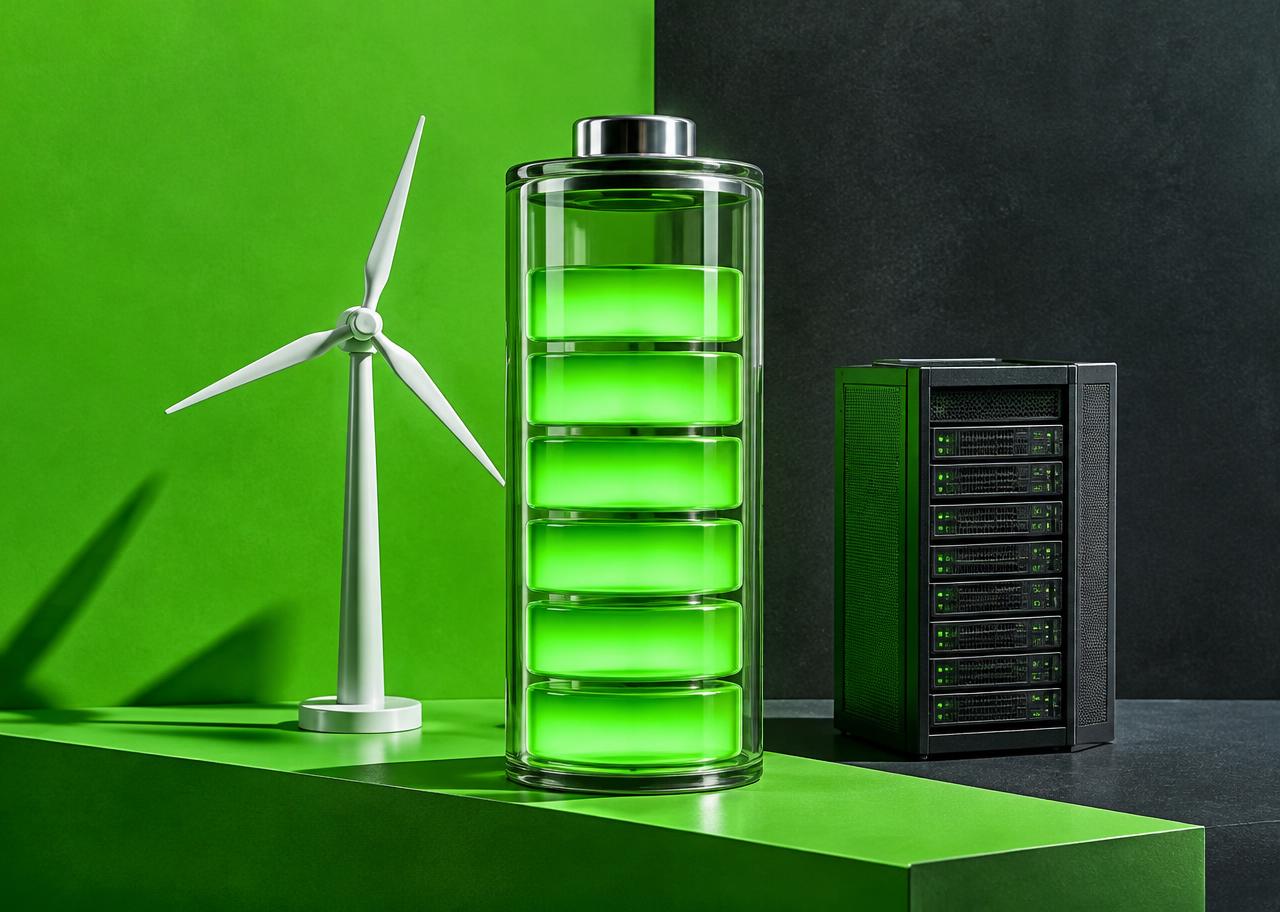
Batteries can make available electricity more useful; they cannot create the electricity AI consumes. The real problem is a portfolio of energy production, deliverable grid capacity, time, reliability and cost—not simply a shortage of battery cells. Global data-center demand is estimated at roughly 485 TWh in 2025 and projected near 950 TWh by 2030, and no single technology will carry that growth alone.
Data-center electricity demand is climbing fast, and tech companies are signing battery, solar and even nuclear deals to keep up. Here is what the numbers actually show—and what each technology can and cannot do.
01 / The story
Demand: what has happened versus what is forecast
The International Energy Agency estimates global data centers used about 415 TWh in 2024 and roughly 485 TWh in 2025, with a central projection of about 950 TWh in 2030—around 3% of global electricity demand. AI-focused consumption grows faster than the total, but these figures cover all data centers, not AI alone. [1, 2]
For the United States, a DOE-supported Lawrence Berkeley National Laboratory report put data centers at about 176 TWh in 2023—4.4% of U.S. electricity—with a 2028 scenario range of 325–580 TWh, roughly 6.7–12%. EPRI's February 2026 scenarios go further: 9–17% of U.S. electricity by 2030, with AI workloads estimated at 15–25% of data-center electricity today. That AI share is an estimate with uncertain attribution, not a meter reading. [3, 4, 5]
One unit warning that prevents most confusion: gigawatts (GW) measure power or capacity; terawatt-hours (TWh) measure energy over time. A 1 GW load running continuously uses 8.76 TWh per year. Saying a company 'added 24 GW of batteries' tells you nothing about how long those batteries can run anything. [2]
02 / The story
The grid is a delivery problem, not just a supply problem
Berkeley Lab's Queued Up: 2026 Edition reports more than 2,060 GW of generation and storage projects seeking transmission-grid connections at the end of 2025. Most applications never become operating projects—and this is a generation queue, not a count of data centers waiting for service. [6]
A signed energy contract does not provide a substation, a transformer, a transmission path or permission to connect. Interconnection studies identify network impacts, upgrades and who pays for them. Local deliverability can constrain a project even when national electricity production is sufficient. [2, 6]
The IEA points to workarounds: onsite generation, storage, demand response and non-firm grid connections that bring faster access in exchange for occasional curtailment. Flexible access is not the same as guaranteed round-the-clock supply. [2]
03 / The story
Batteries: scaling fast, with real limits
The deployment numbers are genuinely impressive. The U.S. Energy Information Administration reported a record 15 GW of utility-scale battery additions in 2025, with 24 GW planned for 2026—developer intent reported in February 2026, not verified completed capacity. IRENA's cost series shows global battery-storage installed costs falling from $2,571 per kWh in 2010 to $192 per kWh in 2024, a decline of about 93%. [7, 8]
But batteries move electricity between times; they do not generate it. Charging requires electricity, and every cycle loses some of it. Duration matters: a 100 MW / 400 MWh battery can supply a constant 100 MW load for about four hours under idealized conditions—not indefinitely. Milliseconds of power-quality smoothing, several hours of load shifting and multi-day renewable shortfalls are different jobs requiring different sizing. [2]
The IEA's April 2026 report suggests 20–25 GW of battery storage could be installed in data centers globally by 2030. That is a forecast, not current deployment, and a different scope from the EIA's U.S. grid-wide figures. [2]
04 / The story
Renewables add energy; they do not deliver it around the clock
IRENA's July 2026 report found that more than 90% of utility-scale renewable projects commissioned in 2025 produced electricity more cheaply than the cheapest new fossil-fuel plant in their market, with global solar at about $44 per MWh and onshore wind around $33 per MWh. [9]
Those are generation costs—not the cost of firm, 24/7 delivered power including transmission, storage, backup and balancing. Annual renewable purchases that match annual consumption are not proof that every hour runs on carbon-free electricity; Google's own nuclear announcement explicitly frames its goal as carbon-free energy every hour, which is a different and harder target. [9, 11]
05 / The story
The nuclear deals: restarts versus first-of-a-kind reactors
Tech companies have signed striking nuclear agreements, but the details matter. Microsoft's September 2024 deal with Constellation is a 20-year power purchase agreement supporting the restart of Three Mile Island Unit 1—renamed the Crane Clean Energy Center, about 835 MW, originally targeting 2028. This is a restart of an existing reactor, not a small modular reactor, and not the accident-damaged Unit 2. [10]
Google's October 2024 agreement with Kairos Power covers up to 500 MW from multiple advanced reactors, with first deployment targeted for 2030. Amazon's October 2024 agreements with Energy Northwest, X-energy and Dominion support potential small modular reactor development. Target capacities and dates are development plans, not electricity already supplied. [11, 12]
More recently, on September 9, 2026, Google announced Finnish infrastructure and energy partnerships, including its first nuclear plant life-extension agreement and heat reuse at Hamina—company-announced plans, not independently audited outcomes. Reuters' April 2026 reporting documents continuing hyperscaler financing interest in next-generation nuclear, not a guarantee that proposed fleets arrive on schedule. [13, 15]
06 / The story
So can technology keep up?
There is no verified single yes or no. Short-duration storage is scaling quickly. Renewables are the cheapest new generation in most markets. Grid connections and firm supply remain the binding constraints in many places, and advanced nuclear is a longer-horizon proposition in the cited deals. [6, 7, 9, 10, 11, 12]
Efficiency is the wild card. The IEA reports rapidly improving energy per AI task—but also increasingly demanding use cases. Better efficiency does not guarantee falling total demand, and cooling, at 7% to over 30% of facility electricity depending on the facility, is only one component of the total. [2, 14]
The honest summary: AI's electricity problem is solvable in pieces and unsolvable as a slogan. Watch completed projects versus announced ones, interconnection queue progress, and hourly carbon-free matching claims. Those numbers will tell you more than any single deal headline.
A closer look
What we verified and what stays uncertain
This guide is desk research based on IEA, DOE/LBNL, EPRI, EIA and IRENA reports plus company announcements, checked on October 17, 2026. National and global totals are compiled or modeled estimates, not a comprehensive network of AI-only electricity meters.
Uncertain as of publication: how much of data-center electricity is truly AI (EPRI estimates 15–25%), how many announced projects will be completed, and whether efficiency gains will outpace demand growth. Forecasts from different organizations use different scopes and methods and are not directly interchangeable.
Put it to work
How to read any AI energy claim
Before believing a number about AI and electricity, check:
0 of 5 considered
These questions are editorial guidance, not a product score or verified assessment.
Keep learning
Further reading
- The AI Data Center Boom: Who Pays If the Investment Doesn't Pay Off?
Qlauson · Cloud and Infrastructure
- What Happens Inside an AI Data Center?
Qlauson · Cloud and Infrastructure
- Local AI vs Cloud AI: Privacy, Cost, Speed, and Performance
Qlauson · AI and Software
- Energy and AI — International Energy Agency, Apr 10, 2025
External resource · Original global data-center demand report and executive summary. Opens in a new tab.
- Key Questions on Energy and AI — IEA, Apr 16, 2026
Primary documentation · Updated outlook: ~485 TWh in 2025, ~950 TWh projected for 2030, 20–25 GW data-center storage by 2030. Checked Oct 17, 2026. Opens in a new tab.
- 2024 United States Data Center Energy Usage Report — Lawrence Berkeley National Laboratory, Dec 19, 2024
Primary documentation · U.S. data centers ~176 TWh in 2023; 325–580 TWh scenario range for 2028. Checked Oct 17, 2026. Opens in a new tab.
- DOE Releases New Report Evaluating Increase in Electricity Demand from Data Centers — U.S. Department of Energy, Dec 20, 2024
Primary documentation · DOE announcement of the LBNL report. Checked Oct 17, 2026. Opens in a new tab.
- Powering Intelligence 2026: Executive Summary — Electric Power Research Institute, Feb 25, 2026
Primary documentation · U.S. scenarios of 9–17% of electricity by 2030; AI share estimate of 15–25%. Checked Oct 17, 2026. Opens in a new tab.
- Queued Up: 2026 Edition — Lawrence Berkeley National Laboratory, Jun 2026
Primary documentation · 2,060+ GW of generation and storage seeking grid connection at end of 2025. Checked Oct 17, 2026. Opens in a new tab.
- New U.S. electric generating capacity expected to reach a record high in 2026 — U.S. Energy Information Administration, Feb 20, 2026
Primary documentation · Record 15 GW battery additions in 2025; 24 GW planned for 2026. Checked Oct 17, 2026. Opens in a new tab.
- Renewable Power Generation Costs in 2024 — IRENA, Jul 22, 2025
Primary documentation · Battery-storage installed cost fell from $2,571/kWh (2010) to $192/kWh (2024). Checked Oct 17, 2026. Opens in a new tab.
- Renewable power generation costs in 2025 — IRENA, Jul 2, 2026
Primary documentation · 90%+ of 2025 utility-scale renewables cheaper than the cheapest new fossil plant; solar ~$44/MWh, onshore wind ~$33/MWh. Checked Oct 17, 2026. Opens in a new tab.
- Constellation to Launch Crane Clean Energy Center — Constellation Energy, Sep 20, 2024
Primary documentation · Three Mile Island Unit 1 restart, ~835 MW, 20-year PPA with Microsoft. Checked Oct 17, 2026. Opens in a new tab.
- New nuclear clean energy agreement with Kairos Power — Google, Oct 14, 2024
Primary documentation · Up to 500 MW from advanced reactors; first deployment targeted 2030. Checked Oct 17, 2026. Opens in a new tab.
- Amazon signs agreements for innovative nuclear energy projects — Amazon, Oct 16, 2024
Primary documentation · SMR development agreements and X-energy investment. Checked Oct 17, 2026. Opens in a new tab.
- Big Tech puts financial heft behind next-gen nuclear power as AI demand surges — Reuters, Apr 10, 2026
Primary documentation · Continuing hyperscaler nuclear financing interest. Checked Oct 17, 2026. Opens in a new tab.
- Energy demand from AI, chapter of Energy and AI — IEA, Apr 10, 2025
Primary documentation · Cooling at ~7% of electricity in efficient hyperscale vs 30%+ in enterprise facilities. Checked Oct 17, 2026. Opens in a new tab.
- Our blueprint for responsible clean energy growth in Finland — Google, Sep 9, 2026
Primary documentation · Recent siting example including a nuclear life-extension agreement and heat reuse. Checked Oct 17, 2026. Opens in a new tab.
Read next
The AI Data Center Boom: Who Pays If the Investment Doesn't Pay Off?
Tech companies are committing hundreds of billions of dollars to AI data centers. We traced the actual disclosures, the financing structures, and the contracts to answer one question: if demand disappoints, who is left holding the bill?
Continue readingNewsletter
Get new Qlauson stories by email.
An occasional email when we publish a new guide or update an important one. No unrelated promotions, and you can unsubscribe from any email.