What an iPhone's Battery Capacity Really Tells You About Real-World Battery Life
The iPhone Duo's EU filing lists 4,883 mAh—more than the iPhone 18 Pro—yet its standardized endurance rating is slightly lower. That is not a contradiction. Here is what capacity numbers can and cannot tell you.
The short answer
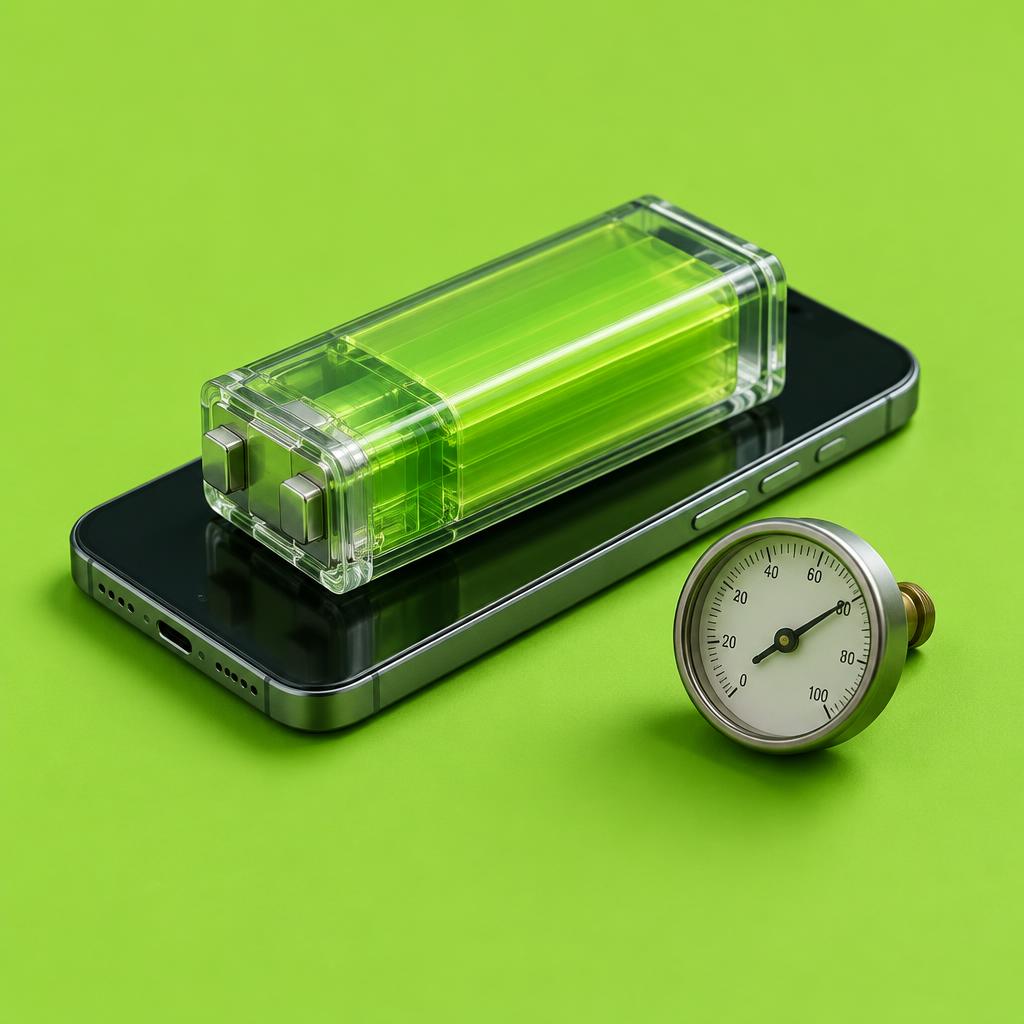
Milliamp-hours measure electrical charge, not energy, and definitely not runtime. The iPhone Duo's EU product sheet lists a rated capacity of 4,883 mAh—about 20% more than the iPhone 18 Pro—but its standardized battery endurance rating is 51.5 hours versus the Pro's 52. Runtime depends on energy (watt-hours), conversion losses, the display, the modem, background work, and how you actually use the phone. Capacity is the size of the fuel tank, not the distance you will drive.
The iPhone Duo's EU filing lists 4,883 mAh—more than the iPhone 18 Pro—yet its standardized endurance rating is slightly lower. That is not a contradiction. Here is what capacity numbers can and cannot tell you.
01 / The story
The number that does not mean what you think
Apple's EU product information sheet for model A3720—the iPhone Duo, per Apple's Taiwan regulatory listing—declares a rated battery capacity of 4,883 mAh, a battery endurance of 51 hours per cycle, and a 1,000-cycle lifespan rating. Technical press reporting from the same sheet cites 51 hours 30 minutes. [1, 2, 3]
Here is the part that surprises people: the iPhone 18 Pro's EU sheet lists 4,056 mAh and 52 hours of endurance, and the iPhone 18 Pro Max lists 5,391 mAh and 62 hours. The Duo has roughly 20% more charge capacity than the Pro, yet a marginally lower standardized endurance rating. [4, 5]
That gap is the whole lesson. Capacity is one ingredient in battery life. The others—energy density, display, modem, software and your personal usage—can easily outweigh it.
02 / The story
mAh versus watt-hours: charge is not energy
Milliamp-hours describe how much electrical charge a battery can deliver under specified conditions. Watt-hours describe how much energy it stores. The rough conversion is Wh = mAh × volts ÷ 1,000, which means two batteries with the same mAh but different voltages do not store the same energy.
For the Duo's dual-battery design, a September 2026 report citing Chemtrec documents puts the two cells at 11.567 Wh and 7.506 Wh—about 19.1 Wh combined. That is credible technical reporting, but it is not from Apple's public spec sheet, so treat it as secondary. [6]
Even watt-hours are not a runtime promise. Protection circuits, voltage cutoffs, temperature and age all reduce how much of the rated energy you can actually use on a given day.
03 / The story
Where the energy actually goes
The display is usually the biggest drain, and the Duo makes this vivid: it has a 5.4-inch outer screen and a 7.6-inch inner folding screen that Apple pitches for viewing, gaming and multitasking. An hour of reading on the small outer display and an hour of gaming on the big inner one are very different energy workloads. [3]
The modem is the second swing factor. Weak or fluctuating signal makes the radio work harder, and time on cellular versus Wi-Fi changes the bill. Apple's own battery-test notes list network, location and signal strength among the factors that make real results vary. [7]
Then there is background work: location services, push email, photo syncing, app refresh and notifications keep radios and processors active while the screen is off. Two people with identical phones can get dramatically different battery life because their apps and settings differ.
04 / The story
How the official numbers are made
The EU endurance figure comes from a defined, standardized test scenario under Delegated Regulation 2023/1669—a weighted value based on tested functions including standby. The European Commission explicitly cautions that label runtime varies with apps, display brightness, network conditions and signal strength. It is a fair cross-model comparison, not a prediction of your day. [8, 9]
The 1,000-cycle rating has a specific meaning too: cycles until remaining capacity falls to 80% of rated capacity, under the regulation's prescribed test and default charging algorithm. It is not a promise that every owner will see exactly that threshold at exactly 1,000 charges. [10]
Apple's own marketing figures—hours of video playback, for example—come from controlled tests on specific units with specific settings. Apple publishes those test conditions and notes that actual results vary. A video-loop hour and a mixed-use hour are different measurements; never compare them directly. [7]
05 / The story
Charging, aging, and making capacity last
Charging speed is not runtime. Apple describes a fast-charge phase up to around 80%, then slower charging, with software limiting current when the battery is warm. Partial top-ups are fine: a charge cycle accumulates when total discharge reaches 100%, not only from a single full drain. [11, 12]
All lithium-ion batteries age chemically. Apple says chemical age reflects temperature history and charging patterns, and that aging reduces charge capacity and can affect peak performance. As capacity fades, the same daily workload consumes a larger share of what remains—which is why a two-year-old phone feels like it drains faster even though your habits have not changed. [12]
The practical habits: keep the phone out of extreme heat, use Optimized Battery Charging, and do not worry about partial charges. None of this will change the rated capacity, but it slows the rate at which your usable capacity shrinks.
A closer look
What we verified and what stays uncertain
This guide is desk research based on EU regulatory product sheets, Apple's published documentation and technical reporting, checked on October 18, 2026. The 4,883 mAh figure and the 51-hour endurance rating come from the EU product information sheet for model A3720, which Apple's Taiwan regulatory listing identifies as the iPhone Duo.
Uncertain as of publication: the separate cell capacities in watt-hours (11.567 Wh plus 7.506 Wh, about 19.1 Wh total) come from technical reporting citing Chemtrec documents, not from Apple's public spec sheet. No independent controlled battery test of a retail iPhone Duo was found in the sources reviewed, and the exact battery chemistry beyond lithium-ion is not confirmed.
Put it to work
How to compare two phones' batteries fairly
Before trusting a capacity headline, check:
0 of 5 considered
These questions are editorial guidance, not a product score or verified assessment.
Keep learning
Further reading
- Can Your Laptop Run AI Locally? Memory, Speed and Real Costs
Qlauson · AI Models & Computing
- Apple HomeView: Apple's Smart-Home Hub, Siri AI, Price and Availability
Qlauson · Emerging Technology
- 4K, HDR, Dolby Vision, and High Frame Rate: What Actually Improves Picture Quality?
Qlauson · Entertainment Technology
- EU product information sheet, model A3720
External resource · Declares 4,883 mAh rated capacity, 51 h endurance per cycle, 1,000-cycle rating. Opens in a new tab.
- Apple Taiwan regulatory product listing
Primary documentation · Identifies model A3720 as iPhone Duo. Checked Oct 18, 2026. Opens in a new tab.
- Apple Newsroom: Apple unveils iPhone Duo (Sep 9, 2026)
Primary documentation · Confirms dual-battery architecture, A20 Pro chip and the two display sizes; does not state capacity. Checked Oct 18, 2026. Opens in a new tab.
- EPREL sheet: iPhone 18 Pro (A3714)
Primary documentation · 4,056 mAh and 52 h endurance for comparison. Checked Oct 18, 2026. Opens in a new tab.
- EPREL sheet: iPhone 18 Pro Max (A3717)
Primary documentation · 5,391 mAh and 62 h endurance for comparison. Checked Oct 18, 2026. Opens in a new tab.
- Macwelt: iPhone Duo battery details (Sep 14, 2026)
Primary documentation · Secondary reporting of the two cells' watt-hour figures from Chemtrec documents. Checked Oct 18, 2026. Opens in a new tab.
- Apple: iPhone Battery Test Information
Primary documentation · Apple's test conditions and the factors that make actual results vary. Checked Oct 18, 2026. Opens in a new tab.
- EU Delegated Regulation 2023/1669
Primary documentation · Defines the standardized endurance and cycle-life metrics. Checked Oct 18, 2026. Opens in a new tab.
- European Commission: Smartphone and tablet consumer guidelines (Jun 8, 2026)
Primary documentation · Cautions that label runtime varies with apps, brightness, network and signal. Checked Oct 18, 2026. Opens in a new tab.
- Apple: Why Lithium-ion?
Primary documentation · Fast-charge phase to about 80%, then slower charging. Checked Oct 18, 2026. Opens in a new tab.
- Apple Support: iPhone battery and performance (Apr 8, 2025)
Primary documentation · Chemical aging, charge cycles and Optimized Battery Charging. Checked Oct 18, 2026. Opens in a new tab.
- Tbreak: iPhone Duo battery capacity (Oct 17, 2026)
Primary documentation · Technical press reporting of the 51 h 30 min figure from the EU sheet. Checked Oct 18, 2026. Opens in a new tab.
Read next
iPhone 18 Pro After a Few Weeks: What Owners Love, What They Dislike, and What Still Needs Fixing
A few weeks after release, iPhone 18 Pro owners have posted praise and complaints in roughly equal measure. We sorted the repeated themes from the one-off stories—and checked which problems Apple has actually acknowledged.
Continue readingNewsletter
Get new Qlauson stories by email.
An occasional email when we publish a new guide or update an important one. No unrelated promotions, and you can unsubscribe from any email.