Apple Music’s “Made by Sound” Rebrand: How Music Shapes Design
Apple Music’s new identity connects an original composition with filmed liquid vibrations. Here is the physical process, the collaborators and what remains unclear.

The short answer
Apple Music announced its Made by Sound identity on October 21, 2026. Apple credits Fred again.. and NEST Acoustics for the original composition; reporting describes a transducer vibrating mineral oil, with the filmed effects feeding the audiovisual identity. It is a branding story, not evidence of new playback features or a universal app rollout.
Apple Music’s new identity connects an original composition with filmed liquid vibrations. Here is the physical process, the collaborators and what remains unclear.
01 / The story
What is Apple Music’s Made by Sound rebrand?
Apple Music introduced a new identity on October 21, 2026 with a simple idea: music should physically help shape the visuals. Its original announcement credits an original composition from Fred again.. and NEST Acoustics. Rather than treating the sound as an unrelated soundtrack added afterward, the campaign connects the audible and visible sides of the brand. [1]
The project is called Made by Sound. Reporting describes a refreshed wordmark, musical-note icon and audiovisual signature built using filmed liquid movement. This is a change in brand expression. The announcement does not establish a new music catalogue, subscription benefit or improvement in playback quality. [2] [3]
Sound visualization is not a new invention, and physical effects are not inherently better than computer animation. What makes this case interesting is the mapping: an original musical composition supplies an input for a material experiment, and the resulting imagery becomes part of the same identity. That is Qlauson’s design analysis, not a claim of unprecedented technology.
02 / The story
Watch the behind-the-scenes film
Video in this section · scroll down to watch
Apple Music’s official YouTube metadata identifies this film as “Apple Music. Made by Sound: Behind the new brand identity.” It is the publisher’s account of the creative process, not independent evidence that no digital finishing was used. The written explanation below distinguishes the announcement from technical reporting. [4]
Loading this video connects to YouTube and may use cookies or similar technologies.
Video: “Apple Music. Made by Sound: Behind the new brand identity” posted by Apple Music on YouTube. Brand identity by Apple Music; the original announcement credits Fred again.. and NEST Acoustics.
Watch on YouTubeApple Music on YouTubeVisit Apple's websiteApple on YouTube
Official YouTube embed for news and educational discussion. Qlauson did not create, download or re-upload the film and is not affiliated with Apple or the collaborators. All rights remain with their respective owners. Promotional footage is not evidence of a service-feature change or universally completed rollout. Links open in a new tab.
03 / The story
How did sound physically shape the visuals?
Adweek and Wallpaper* describe a shallow bath of mineral oil acted on by a transducer. A transducer converts a signal from one form into another; here, audio becomes physical vibration. Musical frequencies move the liquid surface, producing ripples, waves and refractions that are filmed. The recorded effects supply material for the audiovisual identity. [2] [3]
In plain language, the chain is sound → vibration → moving liquid → camera footage → edited brand assets. The liquid is not listening or creating a logo by itself. People choose the composition, apparatus, lighting, framing, captured moments and how those moments are used. That editorial distinction prevents a physical experiment from becoming a misleading “automatic design” story.
The important contrast with a conventional animated effect is the source material. Here, reporting says the visuals originate in a physical interaction between sound and liquid. It does not establish that the finished campaign contains no digital editing, compositing, colour work or other production stages. “Physically shaped” is not synonymous with “untouched footage.” [2] [3]
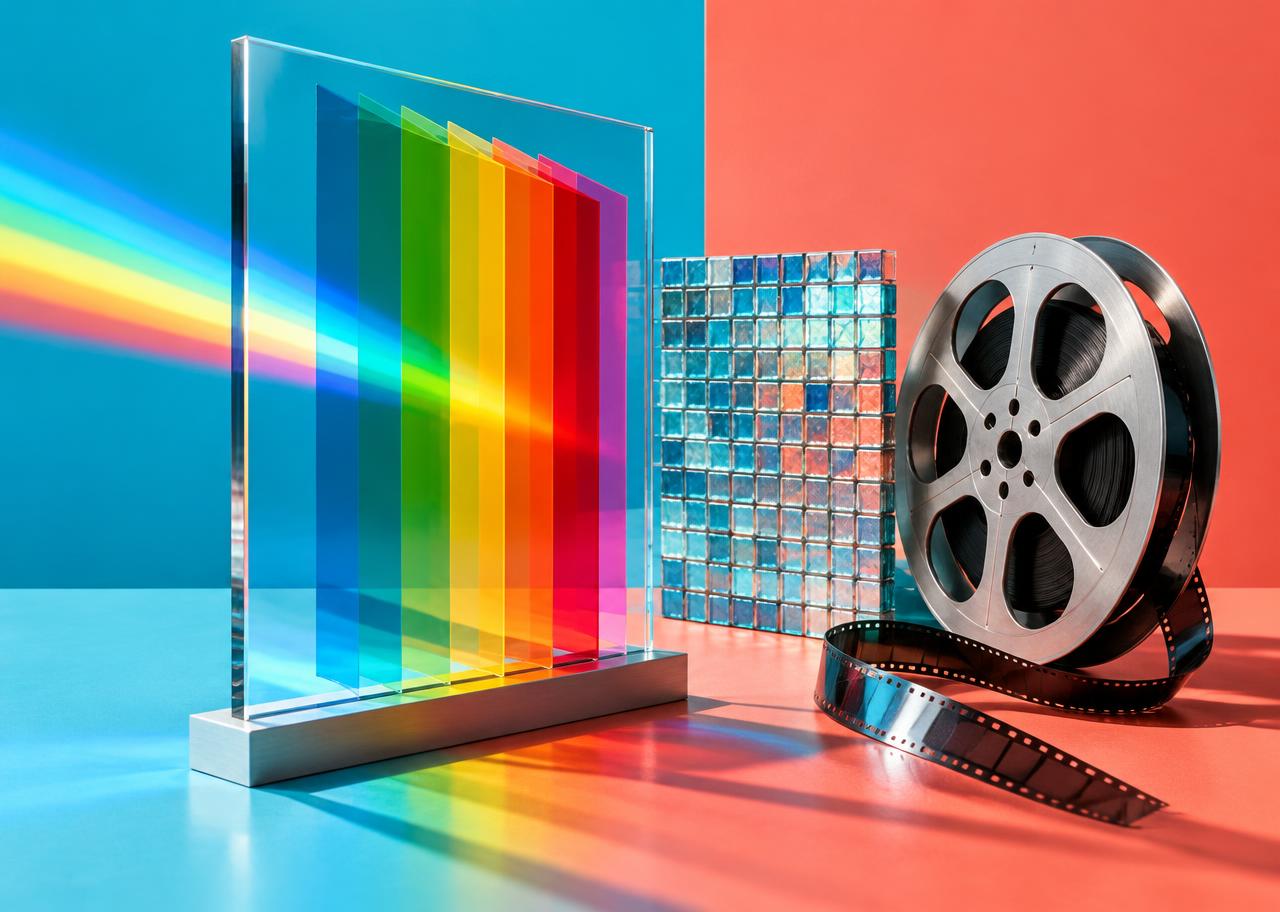
Our conceptual cover illustrates that relationship with a liquid surface and glass ribbon. It is not a photograph of Apple’s apparatus, mineral oil or official identity. Keeping illustration separate from evidence matters especially when a story is about how something was made.
04 / The story
Who worked on the new Apple Music identity?
Apple’s announcement credits Fred again.. and NEST Acoustics for the original composition. Adweek also credits TBWA\Media Arts Lab, the creative agency involved in the identity. Together, these sources establish a music-and-design collaboration, rather than an uncredited automated branding exercise. [1] [2]
The opened accounts support a combined contribution to the composition and sonic signature. They do not establish a precise division of every production task. We therefore do not claim that one named collaborator personally built the rig, engineered every vibration experiment or designed every piece of type.
That restraint is useful when covering creative work. A campaign may involve composition, sound design, physical production, photography, editing, typography and brand planning. Giving people accurate credit is more valuable than constructing a neat but unsupported story about one person doing it all.
05 / The story
What changed in the wordmark and icon?
Wallpaper* describes the Apple symbol paired with bold lowercase lettering using a customized version of SF Pro. It also reports that the reworked musical-note icon draws its shape from forms captured during filming. The identity combines recognizable brand elements with a new liquid-derived treatment. [3]
A wordmark is the written brand name; an icon is a compact identifying symbol. An audiovisual signature combines a short visual sequence with sound. These assets do different jobs: a readable name on a small screen cannot depend on the same amount of motion or detail as a full-screen campaign film.
For an independent publication, describing these changes is different from reusing protected brand assets. Qlauson’s cover uses original still-life objects rather than a modified Apple logo or a fabricated app screenshot. The official film remains on YouTube with its original attribution.
06 / The story
Is this related to Apple’s Liquid Glass design?
Wallpaper* connects the identity’s translucency and refraction with Apple’s Liquid Glass direction, introduced in software in 2025. That connection provides visual context: light, reflection and a glass-like appearance are now recurring parts of Apple’s design vocabulary. [3]
But visual resemblance is not a technical implementation. The filmed brand assets do not, by themselves, tell us how Apple Music’s interface renders, whether a particular operating-system version is required or which accessibility settings apply. A marketing identity and an interface material system are related design subjects, not interchangeable product features.
Qlauson’s interpretation is that a shared visual vocabulary can make campaigns and products feel connected. The risk is using fashionable surface effects without protecting legibility or clear hierarchy. In an app, the information still needs to be easy to read and controls easy to identify.
07 / The story
Will the new logo appear in the Apple Music app?
The sources reviewed do not give one consistent software rollout account. Adweek says the identity begins appearing in original content and event programming during the announcement week, with outdoor advertising also planned. Wallpaper* describes a broad platform rollout. 9to5Mac discusses iOS 27.2 arriving the following week, while Adweek’s account uses different timing for an app-icon change. [2] [3] [5]
The original Apple Music post confirms the identity but not an exact software-release schedule. We therefore do not present a specific app-update day, an iOS-version requirement or universal availability as settled fact. If your app still looks unchanged, that is not evidence that the announced identity is fictional—or that every device has received it.
Likewise, a refreshed logo does not establish a change to audio quality, pricing, library access or playback. Readers comparing subscriptions should examine current service documentation separately rather than treating a design campaign as a new product specification.
08 / The story
Why does the physical process matter for branding?
The first useful idea is a common origin for sound and imagery. When both come from the same composition-driven experiment, the brand can develop a relationship that is more specific than a generic ripple animation with an unrelated jingle. That is a design advantage in principle, not a measured increase in recognition.
The second is variation within a controlled idea. Physical footage can supply detailed movement that a team can select and reuse. But it also needs practical production controls: repeatable lighting, suitable capture and a plan for editing the material into different formats. Nothing in the sources proves physical production is always cheaper, faster or more original.
The third is a story viewers can understand. A behind-the-scenes film shows why an effect belongs to this campaign, not just how polished it looks. The process can strengthen an identity’s explanation without turning a marketing narrative into proof of user preference or commercial success.
09 / The story
What can designers and brands learn from it?
Start with a clear relationship between the elements you want people to remember. A music service has a natural reason to connect sound and visuals; a different company should find its own relevant idea rather than copying the liquid effect. The lesson is coherence, not mineral oil as a universal design tool.
Build for the smallest use as well as the most impressive film. Check the static wordmark, contrast, low-motion presentation and a compact icon. If the identity only makes sense when someone watches a long video with sound enabled, it may not serve everyday use well. These are practical design recommendations, not claims about tests conducted on Apple’s assets.
Keep rights and attribution in the brief from the start. Music, fonts, footage and logos may have different reuse terms. A commissioned film does not automatically grant another publication permission to extract its assets. Link or embed permitted originals and label original explanatory artwork truthfully.
The campaign stands out because it makes sound-to-image design tangible. Its lasting value will depend on how consistently and clearly those assets work across real contexts. Do you prefer a brand identity rooted in physical experiments, or one built entirely with digital tools?
A closer look
Qlauson Team: what we verified
We checked Apple Music’s original announcement, YouTube oEmbed metadata and opened Adweek, Wallpaper* and 9to5Mac reporting on October 22, 2026. The supplied Apple X link pointed to a Claude post; this article cites the corrected Apple Music announcement.
We did not inspect the production apparatus or independently watch every frame of the film. Physical-process details are attributed to opened reporting. Exact software rollout is not established because reports differ. The original illustration is conceptual, not a recreation of official artwork; no Apple logos are reused.
Put it to work
A connected sound-and-design brief
Lessons for a creative team, not an official Apple recipe:
0 of 5 considered
These questions are editorial guidance, not a product score or verified assessment.
Keep learning
Further reading
- Behind Apple's Stop-Motion Gaming Story: The Technology and Craft Behind the Animation
Qlauson · Entertainment Technology
- Can Claude Generate Videos? Opus 5.5 and Motion Graphics Explained
Qlauson · AI Tools
- 4K, HDR, Dolby Vision, and High Frame Rate: What Actually Improves Picture Quality?
Qlauson · Entertainment Technology
- Apple Music — original announcement, October 21, 2026
External resource · Opened original post verifies date and composition credits. Corrects the supplied link, which redirected to a Claude post. Opens in a new tab.
- Adweek — Apple Music Rebrands With a Look Made by Sound
Primary documentation · Opened October 21 report: agency, mineral oil, transducer and rollout context; exact software timing conflicts with other reporting. Checked Oct 22, 2026. Opens in a new tab.
- Wallpaper* — Apple Music’s new visual identity turns sound into liquid
Primary documentation · Opened October 21 report: physical process, wordmark/icon description and Liquid Glass context. Checked Oct 22, 2026. Opens in a new tab.
- Apple Music on YouTube — Made by Sound
Primary documentation · Official oEmbed confirmed title and Apple Music uploader; watch-page access was challenged. Upload date and duration not independently established. Checked Oct 22, 2026. Opens in a new tab.
- 9to5Mac — Apple Music unveils new design rebrand
Primary documentation · Opened report for contextual cross-checking; software rollout discussed cautiously because sources differ. Checked Oct 22, 2026. Opens in a new tab.
Read next
The New Apple TV 4K Explained: What Changes, Who Needs It, and What to Compare
Apple's fourth-generation Apple TV 4K swaps in an A19 chip, far-field microphones, and a Find My-enabled remote for $299. Here is what is genuinely new, what is marketing language, and who should actually upgrade.
Continue reading